
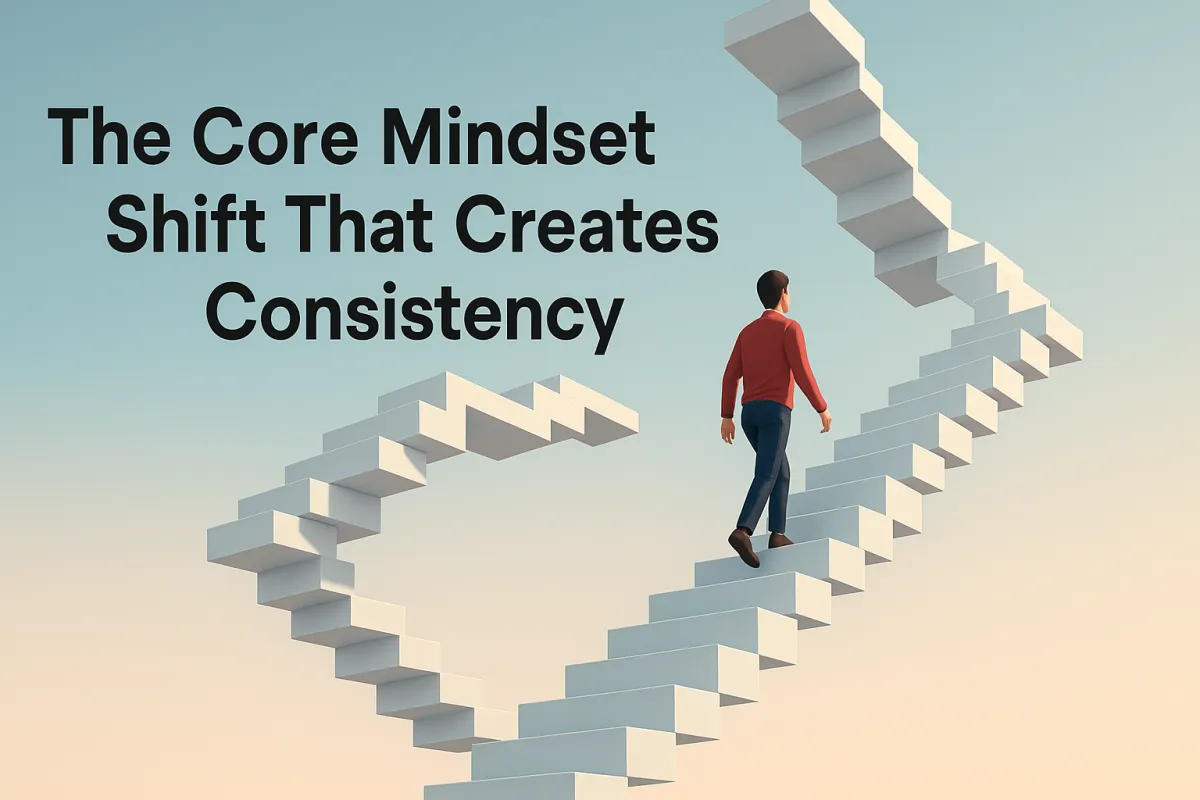
The Core Mindset Shift That Creates Consistency
Last Updated: November 16, 2025
TL;DR
Consistency comes from shifting your mindset from an outcome-focused to an identity-focused one. When you stop trying to hit perfect results and instead see yourself as the type of person who shows up daily, consistency becomes natural instead of forced. The shift is from pressure to identity.
Introduction: Everyone Wants Consistency, but Few Understand What Creates It
Most people think consistency is a discipline problem.
They think it is about motivation, routines, or grinding through discomfort.
But the truth is simple.
Consistency is a mindset problem, not a willpower problem.
If your identity is not aligned with the habit, the habit will always feel heavy.
If your identity supports the habit, the habit becomes automatic.
This guide explains the core mindset shift that creates real consistency and how you can apply it across your business, content, health, and personal goals.
Let us begin.
1. Consistency Fails When the Goal Is Built on Pressure
Most beginners create consistency by setting goals like:
I will post every day
I will work out five times a week
I will create content before noon
I will never miss a day again
These goals sound strong, but they are built on pressure.
Pressure creates:
Anxiety
Overthinking
Avoidance
Fear of failure
Short term effort with no long term repeatability
You cannot build long term consistency on pressure.
Eventually, pressure cracks.
2. Consistency Begins When You Shift From Outcome to Identity
The core mindset shift is simple:
Stop focusing on what you want to achieve and focus on who you want to become.
Examples:
Outcome mindset: I want to post content every day.
Identity mindset: I am the type of person who shares valuable ideas daily.
Outcome mindset: I want to grow my business.
Identity mindset: I am a business owner who shows up even when motivation is low.
Outcome mindset: I want to be healthier.
Identity mindset: I am someone who takes care of my health every day.
Identity drives behavior.
Behavior repeated becomes consistency.
3. Identity Based Habits Create Effortless Consistency
When your actions reflect your identity, the behavior becomes natural.
If you identify as:
A creator
A marketer
A business owner
A writer
A healthy person
A leader
Your brain asks a simple question every day:
What does someone like me do
Someone who identifies as a creator does not battle resistance every day. They create because it is who they are.
Someone who identifies as a business owner does not skip important tasks. They act like a leader because that is their identity.
Consistency becomes automatic when identity supports the action.
4. Identity Based Consistency Removes the Fear of Imperfection
One of the biggest killers of consistency is perfectionism.
Outcome focused people think:
This needs to be perfect
I need the right moment
I need more clarity
I need more confidence
I need more time
Identity based people think:
I show up because this is who I am.
Identity removes the fear of imperfection because the goal is not to get it perfect. The goal is to maintain alignment with who you are becoming.
Consistency thrives in environments where perfection is not required.
5. Identity Creates Smaller, Repeatable Actions Instead of Overthinking
Outcome focused people create huge expectations that paralyze them.
Identity focused people create small, sustainable actions.
Examples:
Outcome: Write a full article daily.
Identity: A writer writes every day, even if it is for 10 minutes.
Outcome: Post three times per day.
Identity: A creator shares value daily, even if it is simple.
Outcome: Build a complete funnel this week.
Identity: A marketer improves the system daily, piece by piece.
Consistency grows through small repeatable actions, not big sporadic ones.
6. Identity Strengthens Through Evidence, Not Intention
You cannot think your way into a new identity.
You prove your way into it.
Identity is built through repeated evidence.
Every time you take action, you reinforce:
I am the type of person who does this
This is part of who I am
This is how I operate
Each repetition strengthens the identity, which strengthens the behavior, which increases consistency.
Consistency builds identity.
Identity fuels consistency.
The cycle compounds.
7. Remove the All or Nothing Mindset to Build Consistency Long Term
Outcome focused thinking leads to all or nothing behavior.
If they miss a day, they feel like they failed.
If they slip up once, they want to reset everything.
If they fall behind, they lose motivation.
Identity focused thinking removes this trap.
If you see yourself as someone who shows up daily, missing one day does not break the identity. It simply becomes a moment, not a failure.
All or nothing kills consistency.
Identity allows flexibility while maintaining direction.
8. Consistency Works Best When You Know Your Minimum Standard
Consistency is not about doing the maximum every day. It is about never letting your minimum fall to zero.
Your minimum standard is the smallest version of your habit that still reinforces your identity.
Examples:
One short post
One paragraph
One email
Five minutes of planning
One simple workout
One task that moves the business forward
Minimum standards create momentum.
Momentum creates confidence.
Confidence creates consistency.
Your minimum keeps you moving even when the day is difficult.
9. Build Systems Around Your Identity to Make Consistency Easier
Identity starts the process.
Systems support it.
You should build systems around:
Scheduling
Templates
Workflows
Automations
Default routines
Pre planned steps
Checklists
Batching tasks
Systems reduce friction.
Friction kills consistency.
Identity creates direction.
Systems make the direction doable.
Together, they create unstoppable momentum.
10. Celebrate the Small Wins That Confirm Your Identity
Most people only celebrate big outcomes, which creates long gaps between motivational spikes.
Identity based people celebrate consistency itself.
They acknowledge:
Showing up
Doing the work
Keeping the promise
Improving even a little
Staying aligned with the identity
Small wins reinforce:
This is who I am now.
This reinforcement makes consistency easier every day.
Conclusion: Consistency Is Not About Trying Harder, It Is About Becoming Someone Who Shows Up
Consistency is a mindset, not a grind.
It comes from shifting your identity from someone who wants results to someone who acts like the person capable of producing those results.
The core mindset shift is simple:
Stop asking what you need to do.
Start asking who you need to become.
When your identity aligns with your actions, consistency becomes effortless, natural, and predictable.
Consistency is not about discipline.
Consistency is about identity.
Mail
Facebook
LinkedIn
X
Pinterest
Reddit
Snapchat