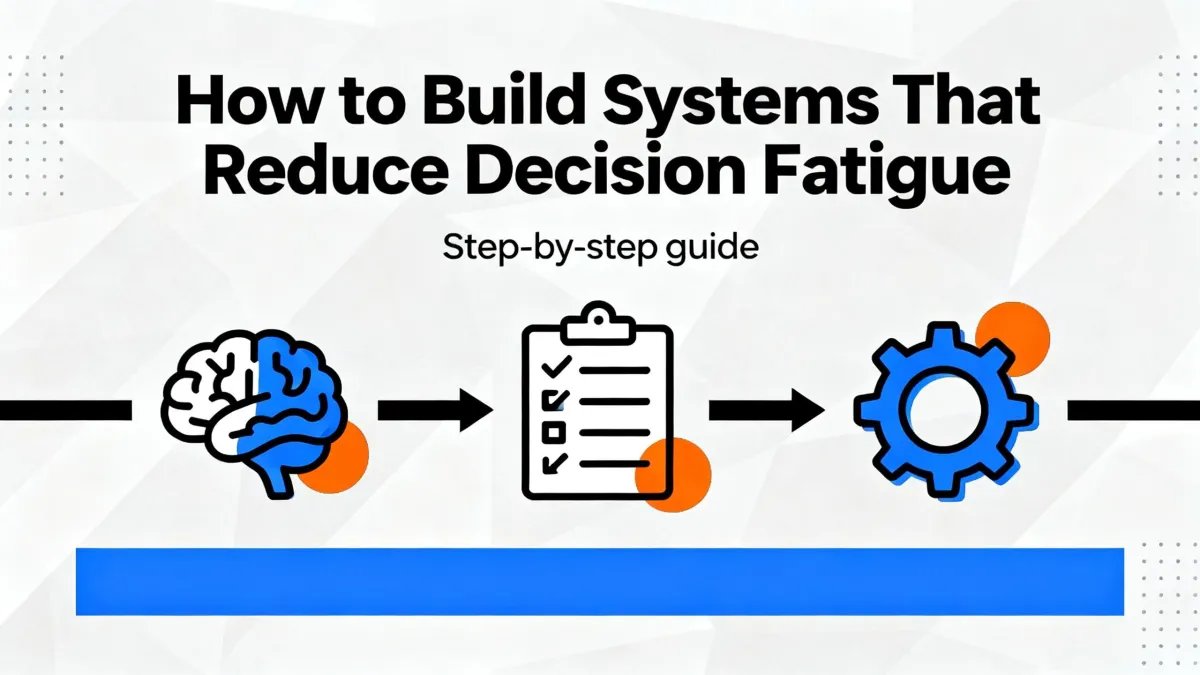
How to Build Systems That Reduce Decision Fatigue
Last Updated: January 4, 2026
Quick Answer
Decision fatigue happens when you make too many small choices throughout the day, which drains your mental capacity. You reduce it by building systems that automate repeated decisions, limit variables, and standardize your workflows so your mind stays free for high value work.
Most people think burnout comes from doing too much. Usually, it comes from deciding too much. When you build a business, every task pulls at you. Every option looks urgent. Every idea feels like something you should have acted on already. The real cost is not the work itself. It is the friction of deciding what to do, how to do it, and when to do it.
That friction compounds. It shows up in your dropped habits. It shows up in your scattered focus. It shows up in the moments you sit at your desk and cannot think clearly even though your body is not tired at all. That is decision fatigue. It is the silent tax on performance that creators, founders, and operators pay daily.
Systems remove that tax. Systems let you protect your output by protecting your attention. Once you understand that every repeatable part of your life should have a structure, you start making progress faster with less stress.
This article will show you how to build those structures and remove the daily drain that keeps most people stuck.
Why Decision Fatigue Destroys Productivity
Decision fatigue is not dramatic. It does not announce itself. It is gradual and invisible, which makes it dangerous.
You lose clarity because you are constantly switching mental lanes. You lose time because every micro decision steals a few seconds of processing power. You lose energy because your brain treats every choice as a cost, even if it is small.
Here is the hidden truth. Your output is rarely limited by skill. It is limited by the amount of clean decision making energy you have left after you spend the day reacting to everything around you.
The worst part. Most people think this is normal. They think their inconsistency is a discipline problem. In reality, they simply have no systems supporting them.
If you eliminate repeated decisions, you eliminate repeated friction. When friction drops, consistency rises. When consistency rises, results compound.
The Foundation of a System That Protects Your Mind
A real system has four ingredients.
Clear rules
Rules remove variables. When you know exactly how something works, you do not think about it.Repeatable steps
Anything you do often should follow the same sequence each time.Minimal required thought
Systems are designed to reduce thinking, not increase it. If a system makes your day harder, it is not a system. It is noise.A feedback loop
You need a simple way to track whether the system is doing its job.
These four ingredients are the difference between structure and chaos. Most people skip the rules. They skip the sequence. They skip the feedback. They just hope things work. That hope drains them.
The Daily Decisions That Cost You the Most
You do not need to remove every decision. You only need to remove the ones that repeat daily because those are the ones that drain you the fastest.
Here are the decision categories that create the most fatigue.
1. What to work on
If you start your day by asking what you should do, you have already lost momentum.
2. How to do the work
If every task feels like you are reinventing the process, you waste energy before you ever start.
3. When to work on each task
Open schedules are traps. They force you to constantly choose the next step.
4. What to ignore
Most indecision comes from not knowing what is irrelevant. Systems create filters.
When these four categories have structure, you move through your day with clarity. When they do not, your brain burns energy on choices that produce no value.
Build the System That Decides for You
This is the part where creators and business owners feel the most relief because once these systems are in place they start doing the heavy lifting for you.
Below are the core systems that eliminate the most fatigue.
1. A Fixed Daily Workflow Template
Your day needs a structure that repeats. Not a schedule filled with random tasks. A template that tells you exactly how the day flows.
Here is a simple example.
Morning Block
• Review your top priorities
• Execute the most important task
• Avoid communication platforms until the first checkpoint
Midday Block
• Handle admin or medium level tasks
• Execute workflows that require less creativity
Afternoon Block
• Meetings
• Review progress
• Plan tomorrow’s tasks
This template removes the question of what goes where. You plug tasks into the structure instead of building the structure from scratch every day.
2. A Priority Formula That Never Changes
You need a ranking system that decides which tasks matter without emotional bias.
Here is a three part formula.
Revenue impact
Does it increase revenue or protect revenue?Irreplaceability
Are you the only person who can do it?Compounding value
Will the work create ongoing benefits?
Tasks that score high on all three get done first. This removes the trap of reacting to the loudest problem instead of the most important problem.
3. A Standard Operating Procedure for Every Repeated Task
If you do something more than three times, write the process.
A real SOP includes:
• The step sequence
• Required tools
• Decision rules
• Quality checks
This removes the fatigue created by reinventing tasks that should feel automatic.
And yes, this follows the formatting advice in your SEO and AIO PDFs about lists, clarity, and immediate action steps for the reader
SEO + AIO Checklist (2)
4. A Weekly Review That Resets the System
Once per week, you review:
• What worked
• What did not
• What bottlenecks slowed you down
• What tasks repeated too often
• What decisions created the most friction
This is your feedback loop. Without it, you do not refine your systems. You simply repeat stress cycles.
5. A “Non Negotiable” List That Removes 80 Percent of Micro Decisions
A non negotiable list protects your energy by eliminating debates with yourself.
Examples:
• Start work at the same time
• Limit meetings to certain time blocks
• No new projects added without a defined workflow
• No notifications during deep work
These rules remove thousands of tiny choices that wear you down.
Why Systems Make You Feel More Creative, Not Less
A common belief is that systems restrict creativity. The opposite is true.
Creativity requires mental space. It requires freedom from noise. When your entire day is filled with unsorted decisions, you cannot think clearly enough to innovate.
Systems give your brain room to breathe. They create structure so your creative energy can be spent where it matters.
When you do not need to think about your workflow, you can think about your growth. When you do not need to think about your next move, you can think about the future. That freedom is where breakthroughs come from.
The Real Reason Most People Avoid Systems
Building systems requires you to confront your own chaos. Chaos feels flexible. Chaos feels exciting. Chaos lets you pretend you are productive because you are constantly busy.
But chaos consumes you. It slowly eats your capacity, your consistency, and your confidence.
Systems do the opposite. They make your world predictable. They remove drama. They remove emotional decision making. They let you win by discipline instead of adrenaline.
That shift is uncomfortable at first. Then it becomes addictive because it works.
A Simple 7 Step System to Control Your Workday
This is the part of the article designed for scannability and snippet extraction, following the checklist guidance from your PDFs about lists and clarity
SEO + AIO Checklist (2)
.
1. Identify every repeated task in your week
Create a list of everything you do more than twice.
2. Remove anything unnecessary
If it does not create output or protect output, eliminate it.
3. Write a mini SOP for each repeated task
Keep it simple, structured, and easy to follow.
4. Build a weekly template
Divide work into fixed blocks with a natural rhythm.
5. Automate or delegate anything that does not require your skill
Your energy should serve your highest leverage.
6. Create rules that remove uncertainty
Protect your time through constraints.
7. Review weekly and refine
Your systems improve as your awareness improves.
This list becomes the backbone of your productivity. Each step lowers your cognitive load a little more.
What Life Looks Like With Decision Fatigue Removed
You begin your day with clarity.
You move through tasks without hesitation.
You finish work with energy left instead of feeling drained.
You make fewer mistakes because your system prevents them.
You produce more because your brain is not burning fuel on trivia.
High output does not come from working harder. It comes from eliminating the noise that steals your best work before you ever sit down to do it.
When you remove decision fatigue, your business grows because you finally have the mental bandwidth to think long term.
Conclusion
Decision fatigue kills momentum. Systems protect it. When you build workflows that limit decisions, you reclaim the energy you need to perform at your highest level. You reduce friction, increase speed, and create consistency that compounds over time.
The most successful creators and operators do not rely on motivation. They rely on structure. They intentionally design their days so that every important choice has already been made before the day starts.
Your systems are not just about productivity. They are about protecting your mind so it can perform at a level that moves your business forward. Build the systems once and the benefits compound for years.
Mail
Facebook
LinkedIn
X
Pinterest
Reddit
Snapchat