
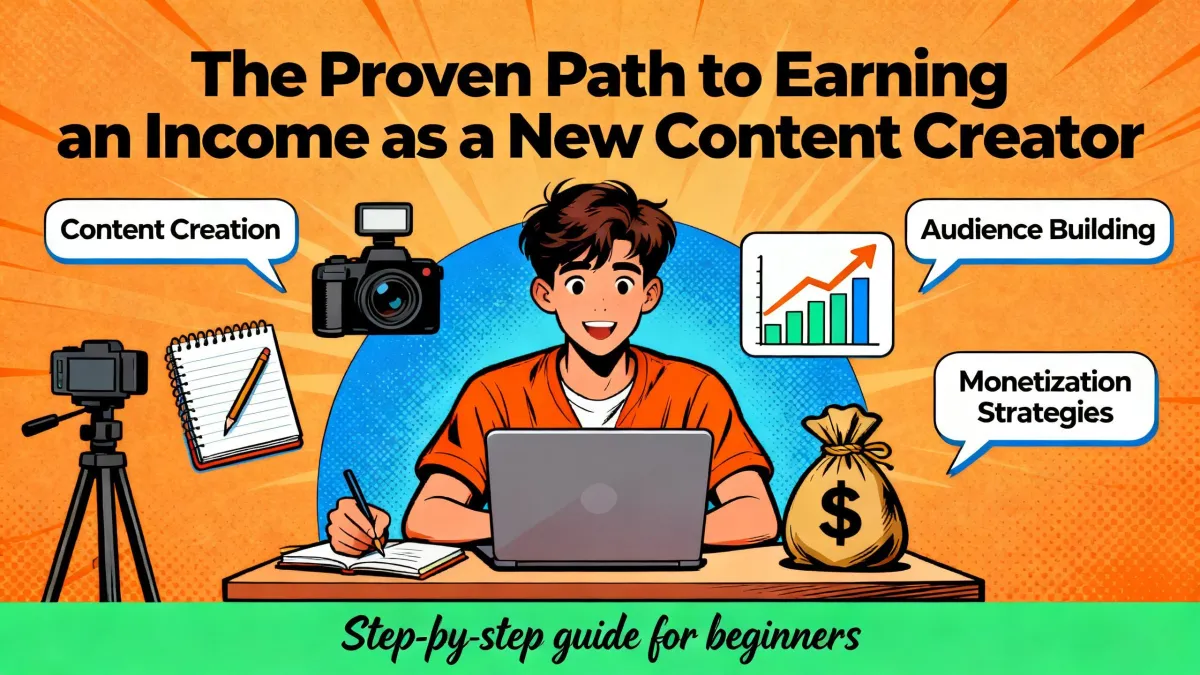
A Practical Path to Earning an Income as a New Content Creator
Last Updated: November 4, 2026
Quick Answer:
A practical path to creator income is to learn one format, publish useful teaching, understand a specific audience, and test a clear offer that addresses a real need. Trust matters, but income also depends on demand, pricing, delivery, and costs. No publishing sequence guarantees earnings.
Most new creators try everything. They jump from platform to platform. They switch formats weekly. They chase viral trends and wonder why none of it leads to money. The problem is not lack of effort. The problem is lack of structure. If you want to earn income as a creator, you need a proven path, not random attempts.
At Greatness Gained, creator work starts with stewardship: use your skills to help people, communicate honestly, and build a business you can responsibly operate. First Peter 4:10 describes using our gifts to serve others as stewards of God’s grace. Applying that principle to business means treating the audience as people to serve, with needs and limits you should respect.
Use this framework to organize your work and test whether people want what you can deliver. Start within your time and budget. Protect family responsibilities, avoid spending on equipment before you need it, and improve your offer using actual customer feedback.
Why Most New Creators Never Make Money
Creators do not struggle because they lack talent. They struggle because they try to monetize without a foundation. They want income before they build identity, trust, structure, or consistency.
Here are the most common reasons new creators fail to earn:
1. They try to be everywhere instead of mastering one platform.
Spread too thin means no depth.
2. They post without a strategy.
Content becomes a random act instead of a purposeful signal of expertise.
3. They focus on views instead of trust.
Views create attention. Trust creates income.
4. They sell too early or too vaguely.
A confused audience never buys.
5. They do not understand the buyer journey.
People do not buy because you create content. They buy because your content solves a problem they care about.
Monetization starts long before the sale. It starts with how you show up.
The Proven Creator Income Framework
There are five stages on the income path for new creators:
Choose your identity
Master one format
Build an audience with consistent value
Move attention into deeper connection
Introduce an offer that solves a real problem
These stages provide a starting structure. They can overlap: a service provider may already have customers, while a new educator may need more practice and audience research. Use what fits your situation and measure whether it helps.
Let’s break each stage down clearly.
Stage One: Choose Your Creator Identity
Your identity is the foundation of your creator brand. Without clarity here, everything else becomes harder.
Your creator identity answers three questions:
1. Who do you want to help
Not everyone. A specific type of person with a specific problem.
2. What problem do you solve for them
This becomes the through line in your content.
3. What lens or perspective do you bring
This is what makes you memorable.
Examples of clear identities:
• The creator who helps beginners get their first freelance client
• The creator who teaches simple fitness for busy parents
• The creator who explains business ownership using everyday language
• The creator who helps entrepreneurs use AI for marketing
A clear focus helps people understand whom your work is intended to serve. For a Christian creator, that focus should also reflect convictions you will keep when money is involved. First Peter 4:10 describes gifts as something entrusted to us for serving others. Identify a real skill you can use responsibly, the limits of your experience, and the people who could benefit from your help. You do not need to present yourself as an expert in everything to make a useful contribution.
Stage Two: Master One Content Format
Most creators fail because they try to do long form, short form, email, podcasts, and graphics all at once. This leads to frustration and inconsistency.
Master one format before adding anything else.
Here are the top three beginner friendly formats:
Short form video
Fast to create, highly discoverable, and works on multiple platforms.
Long form educational posts
Ideal for creators who explain ideas clearly.
Simple talking head videos
Low production, high trust.
Your best format is the one you can produce consistently without burnout. Skill grows with repetition, and repetition requires simplicity. Keep your format simple.
Stage Three: Build an Audience Through Valuable Content
Income only shows up when you build trust, and trust is built through content that helps people understand their problem better than they understood it before.
Most creators publish content that entertains but does not build authority. If you want income, you need authority content.
Here is the content mix that works best for new creators:
1. Problem awareness content
Show people the real reason they struggle with their issue.
2. Demonstration content
Show your method, process, framework, or system.
3. Insight content
Explain something in a simple way that makes people say, “I never thought of it like that.”
4. Identity content
Share your beliefs, philosophy, and viewpoint.
5. Quick wins
Give them something they can implement today with noticeable improvement.
This mix builds trust because it shows your audience three things:
• You understand their problem
• You can explain solutions clearly
• You have a method that works
Trust gives people a reason to consider your offer. A sale still requires a relevant need, an acceptable price, and confidence in delivery. Earn trust through truthful demonstrations, clear limitations, and useful teaching.
Stage Four: Move Attention to a Controlled Environment
Attention is fragile on social media. Platforms can throttle your reach, shift the algorithm, or remove your account entirely. If you want income, you must move your audience from rented platforms to a controlled environment.
Choose one:
• Email list
• Newsletter
• Community group
• Private channel
Here is why this matters:
1. Ownership
You control communication instead of relying on algorithms.
2. Depth
People connect more deeply in private spaces than public feeds.
3. Conversion
Email and community spaces let you answer questions and explain an offer in more detail. Compare your own results rather than assuming one channel will always convert better.
Choose the channel you can maintain responsibly. An email list offers a direct contact method, while communities and private channels still depend on their hosting platforms. Invite people willingly and explain what they will receive.
Stage Five: Introduce an Offer That Solves a Real Problem
Monetization begins here, but only after trust has been built. Your first offer should be simple, clear, and directly tied to the problem your audience wants solved.
Here are three offers to evaluate against your skills, capacity, and audience needs:
1. A starter digital product
A guide, template, mini course, or toolkit that helps them solve one small but important problem.
2. A service or coaching call
A personalized plan, audit, or session. Perfect for beginners because it requires no complex delivery systems.
3. A subscription or community
Only introduce this once you understand your audience deeply.
Before testing your offer, check three conditions:
• It solves a painful problem
• It is priced fairly for beginners
• It is easy to understand in under ten seconds
Explain the offer clearly, including the work required, what is included, and what is outside its scope. Proverbs 11:1 condemns dishonest scales, a reminder that fair dealing belongs in the substance of the transaction. A small product should deliver the help its description promises. A service should stay within your competence. A subscription should have a clear ongoing purpose and honest terms. The fact that a buyer trusts your Christian values makes accuracy more important, not less.
The Three Invisible Skills Every Earning Creator Develops
Skill one: clarity
Skill two: consistency
Skill three: communication
These are not optional. They are the backbone of your creator business.
Skill One: Clarity
You need clarity in three areas:
• Who you help
• What problem you solve
• What process you use
Most creators speak in vague terms. Vague content attracts vague attention which creates vague income. Clear messaging creates sharp results.
Skill Two: Consistency
Consistency is not about posting every day. Consistency is about building expectations.
Your audience should know:
• What you talk about
• How you help
• How often you show up
Consistency builds familiarity, and familiarity builds trust.
Skill Three: Communication
Clear communication is one part of useful creator work, alongside knowledge, judgment, delivery, and demand. Ephesians 4:29 gives a practical standard for the message: does it build people up according to their needs? Explain what the reader can do, identify important limitations, and resist the temptation to make a promise stronger simply because it attracts more attention.
Your content should be written like you are explaining something to a friend. Simple, direct, and specific. Not academic. Not vague. Not overly produced.
This approach increases reader satisfaction and aligns with best practices for scannable, conversational content.
What You Should Not Do as a New Creator
Avoid these common traps:
1. Do not chase trends.
Trends bring views, not income.
2. Do not create for everyone.
Specificity builds authority faster.
3. Do not wait to post until everything is perfect.
Action beats perfection every time.
4. Do not create without a structure.
Structure builds speed and clarity.
5. Do not skip the audience building stage.
Income comes last, not first.
Your path becomes easier once you remove the mistakes that slow most beginners down.
The Simple Step by Step Path to Earning Your First Dollar
Here is the streamlined version of the process:
Pick one niche problem you can help with
Create a simple creator identity tied to that problem
Choose one content format
Post three to five times a week
Build trust with educational and insight content
Move your audience to a controlled environment
Create one simple offer
Test it and refine it
Deliver excellent value
Repeat
Use this sequence to run a small test. Record how many people see the offer, ask questions, buy, and request support. Compare revenue with delivery costs and time. If interest is low, examine the problem, audience, offer, and message before producing more content.
How to Adapt the Framework to Your Audience
This framework gives you a way to test an audience, a useful lesson, and an offer. Its value depends on what you learn and how responsibly you deliver. Matthew 6:24 warns that we cannot serve both God and money. Earning income through honest work can support your household and generosity, but income must not become the authority that decides every commitment. Before increasing your publishing schedule or launching another offer, ask what the decision would require from your family, customers, and conscience. A revenue target should serve your responsibilities rather than replace them.
Humans buy from creators they trust.
Humans trust creators who show up consistently.
Humans follow creators who give them clarity, direction, and insight.
Platform distribution still affects how people discover your work. Reduce dependence on a single platform by building direct relationships and keeping useful resources on your own website. Continue learning how your audience finds and evaluates your offer.
The Creator Momentum Principle
Momentum builds from simple actions repeated consistently:
• One clear niche
• One platform
• One content style
• One offer
• One path
Most creators fail because they keep changing direction before momentum builds.
Your job is not to do everything. Your job is to maintain direction long enough for the payoff to show up.
Frequently Asked Questions
How long does it take to make money as a creator
There is no reliable universal timeline. Existing skills, demand, audience access, pricing, and the offer all affect results. Some creators earn quickly; others take much longer or never earn enough to cover their costs.
Do I need a large audience to make money
No. Many creators earn with fewer than one thousand followers by offering coaching, services, or digital products.
What platform should I start on
Choose the one you can post on consistently. Short form video and written posts are usually the fastest for beginners.
Do I need professional equipment
No. Clear audio or simple text based content is enough to start.
Conclusion
Choose a specific problem, practice one format, publish useful teaching, and test a clear offer. Keep your promises and evaluate whether the work is profitable after costs. Repetition gives you more opportunities to learn; it does not make income inevitable.
Before you publish, ask: Is this true? Can the reader use it? Can I deliver what I am offering? Those questions connect Christian conviction with everyday business decisions.
This week, outline one lesson, publish it in your strongest format, and ask your audience what they still need help with. Use their answers to shape a modest first offer. Serve well, keep your costs visible, and build at a pace your household can sustain.
Mail
Facebook
LinkedIn
X
Pinterest
Reddit
Snapchat