
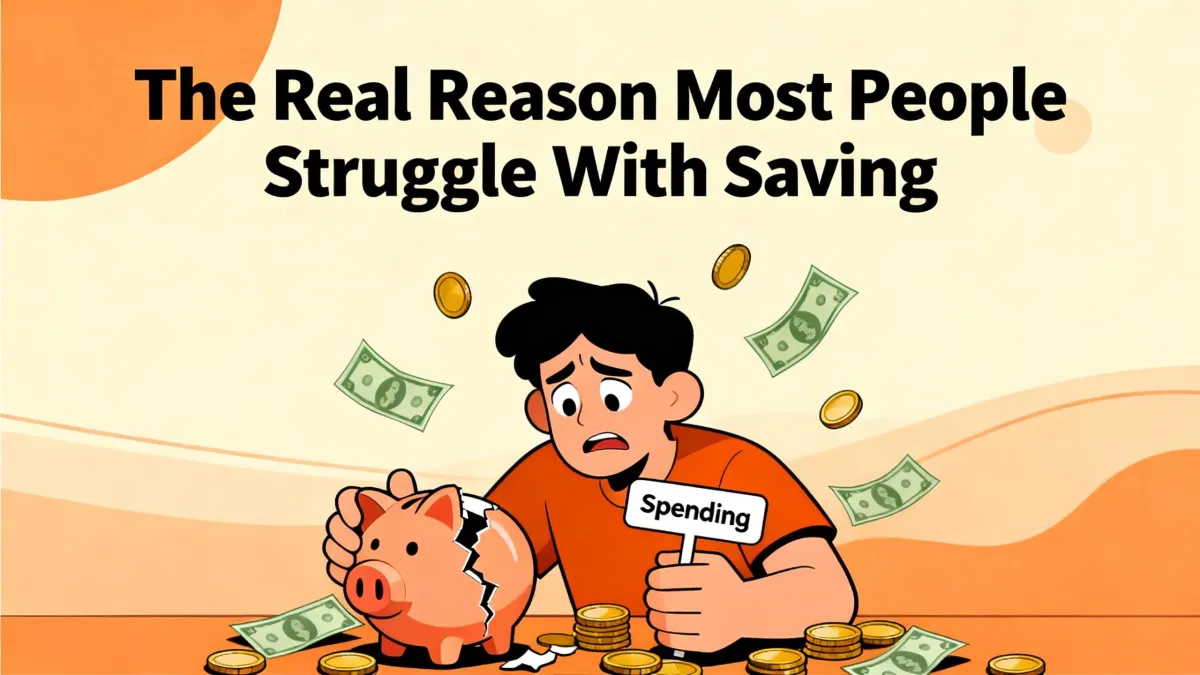
The Real Reason Most People Struggle With Saving
Last Updated: December 28, 2025
Quick Answer:
Most people struggle with saving because saving is not a math problem. It is a behavior problem driven by unclear priorities, emotional spending patterns, and a lack of simple systems that remove daily decision making. Once you remove emotion and replace it with structure, saving becomes automatic.
Most people think they have a money problem. They think the reason they cannot save is because they are not earning enough or because life is too expensive or because something external keeps getting in the way. It feels logical. If there is not enough money left, how could saving be possible?
But lack of savings rarely comes from income. It comes from a lack of structure. It comes from habits that run on autopilot. It comes from emotional spending triggered by stress, reward, boredom, or pressure. When money does not have a plan, it gets used by default. The real issue is not the amount. The real issue is the system that money flows through.
This is why the majority of people struggle even when their income increases. Their lifestyle rises. Their habits rise. Their emotional spending rises. But their structure stays the same. Saving becomes a wish instead of a system.
The good news is that saving becomes simple the moment you understand the real reason people fail at it. And once you understand the core issue, you can build a system that makes saving predictable.
This article breaks down the true struggle behind saving, the psychology behind it, and the steps that help you take control permanently.
Why Saving Feels Harder Than It Should
Saving feels difficult because people think of it as a discipline problem. They assume that saving requires willpower and strong self control. But discipline is unreliable. It fluctuates based on stress, energy, mood, and environment.
Here is what actually makes saving feel hard:
1. There is no clear priority.
Savings goals feel vague. Without clarity, money gets spent on whatever is most urgent in the moment.
2. Spending is emotional, not logical.
Money decisions are controlled by mental shortcuts and triggers. Almost no one makes financial decisions based on math.
3. People underestimate the small leaks.
It is not the big purchases that drain accounts. It is the repeated small choices that add up silently.
4. There is no system to make saving automatic.
If saving requires effort or remembering, it eventually collapses.
5. There is no identity behind the habit.
When saving is not part of who you believe yourself to be, it never sticks long term.
Saving only becomes difficult when the system around it is unclear or nonexistent. Once you give money a clear structure, saving becomes simpler than most people expect.
What Your Brain Is Doing When You Try to Save
People imagine they make money decisions rationally. In reality, they make them emotionally, then justify them with logic afterward.
Your brain has two primary modes when it comes to money:
1. Present bias
Your mind values immediate rewards over future rewards. Saving loses to spending because spending feels good now and saving feels like losing something.
2. Cognitive load
Every decision drains energy. The more decisions you make daily, the harder it becomes to make smart financial choices at the end of the day.
This is why the saving problem cannot be solved through discipline. It can only be solved by reducing decisions.
When you reduce decisions, you reduce friction. When you reduce friction, money flows into the right places naturally.
The Hidden Forces That Keep People From Saving
There are three forces at play that most people never notice.
Force One: Lifestyle Drift
Lifestyle drift happens when expenses increase as income increases. When more money comes in, spending expands automatically.
It feels harmless because it happens slowly.
A better apartment.
More frequent eating out.
Upgraded phone plan.
More subscriptions.
One day you look at your account and realize nothing changed except the cost of your daily life.
People struggle to save not because they live wildly beyond their means but because they live slightly beyond them. That small difference compounds in the wrong direction.
Force Two: Emotional Spending Loops
Most spending is not logical. It is emotional.
People buy to:
• Reduce stress
• Escape boredom
• Reward themselves
• Feel progress
• Avoid discomfort
If money is your coping mechanism, saving will always feel impossible.
The solution is not budgeting every penny. The solution is building awareness and replacing the emotional loop with something that does not drain your bank account.
Force Three: Lack of a Simple System
If saving requires thinking, tracking, or remembering, it is already too complicated.
You need a system that works even on your worst days.
A system turns saving from a choice into a default.
When saving is automatic, you no longer rely on motivation. You rely on structure.
The Real Reason Most People Cannot Save
After helping thousands of people improve their financial lives, a pattern appears every time.
People do not struggle with saving because they are irresponsible. They struggle because they try to save with the wrong approach.
They try to save through intention instead of system.
Saving works only when your environment, your habits, and your identity support the outcome. Saving fails when you depend on willpower.
Here is the truth most people avoid:
If your system is weak, your habits will always overpower your intention.
People do not fail because saving is hard. They fail because their system makes saving optional.
Your system should make saving non negotiable.
Why a Simple Money System Solves the Problem
A simple money system solves the saving problem because it restructures how money flows. It removes decision making, emotion, and stress from the equation.
One of the most effective approaches is the three account method:
• Spending account
• Freedom or savings account
• Growth account
This creates separation between the money you use, the money you protect, and the money you grow.
Most people struggle with saving because everything sits in one place. When all your money mixes together, your brain sees it as available. When your accounts are separated, your brain treats each one differently.
Structure creates clarity. Clarity creates control. Control creates consistency.
The Psychology of Automatic Saving
Automation is the core solution for people who struggle with saving.
Why?
Because automation bypasses:
• Decision fatigue
• Emotional spending
• Temptation
• Forgetfulness
• Motivation fluctuations
Automation creates a predictable rhythm. When saving occurs automatically, your brain stops treating saving as a sacrifice and starts treating it as a normal part of your financial life.
Five Saving Habits That Actually Work
Here are five saving habits that create real long term results.
Habit One: Save before you spend
Most people save after they spend. This guarantees failure. Saving must happen first.
Automation helps, but the mindset matters. Saving becomes a priority instead of an afterthought.
Habit Two: Review your spending weekly
Weekly reviews create awareness without judgment.
You are not tracking every penny. You are simply observing your behavior. Awareness is the antidote to unconscious spending.
Habit Three: Remove one recurring expense every quarter
Single decisions repeated forever create incredible momentum.
If you eliminate one recurring cost every three months, your savings will grow without lifestyle pain.
Habit Four: Increase savings slowly
Do not jump from saving zero to saving thirty percent.
Increase in small increments.
Your brain adapts. Your lifestyle adapts. Your savings grow effortlessly.
Habit Five: Build a saver identity
Identity shapes action.
If you see yourself as someone who saves, your behavior changes automatically. Your decisions follow your identity, not the other way around.
Why Saving Becomes Easy Once the System Is in Place
Saving becomes easy when:
• You reduce decisions
• You remove emotions
• You simplify the structure
• You automate the flow
• You create identity behind the habit
Humans are not wired for long term thinking. That is why systems must do the heavy lifting.
People struggle with saving for the same reason they struggle with any habit. They rely on hope instead of structure. They wait until they feel ready instead of creating a system that works even when they do not.
Once you fix the system, you fix the struggle.
A Simple Saving Framework You Can Start Today
If you want a saving habit that lasts, follow this three step framework.
Step One: Decide the percentage
Pick a realistic number. Not a perfect one. Not an impressive one. A sustainable one.
Step Two: Automate the transfer
Set it to happen on payday. Remove all decisions from the process.
Step Three: Separate the accounts
Put your savings where you cannot easily spend it.
Once this is in place, saving stops feeling like a sacrifice. It becomes a normal part of your financial rhythm.
Conclusion
Most people struggle with saving not because they lack discipline but because they lack structure. Saving becomes impossible when everything depends on willpower and emotional decision making. It becomes simple once you automate the process, separate your money, and build a system that makes saving effortless.
The real reason saving feels hard is because the system supporting it is weak. Strengthen the system and saving becomes automatic. You do not need more discipline. You need a better structure.
Mail
Facebook
LinkedIn
X
Pinterest
Reddit
Snapchat