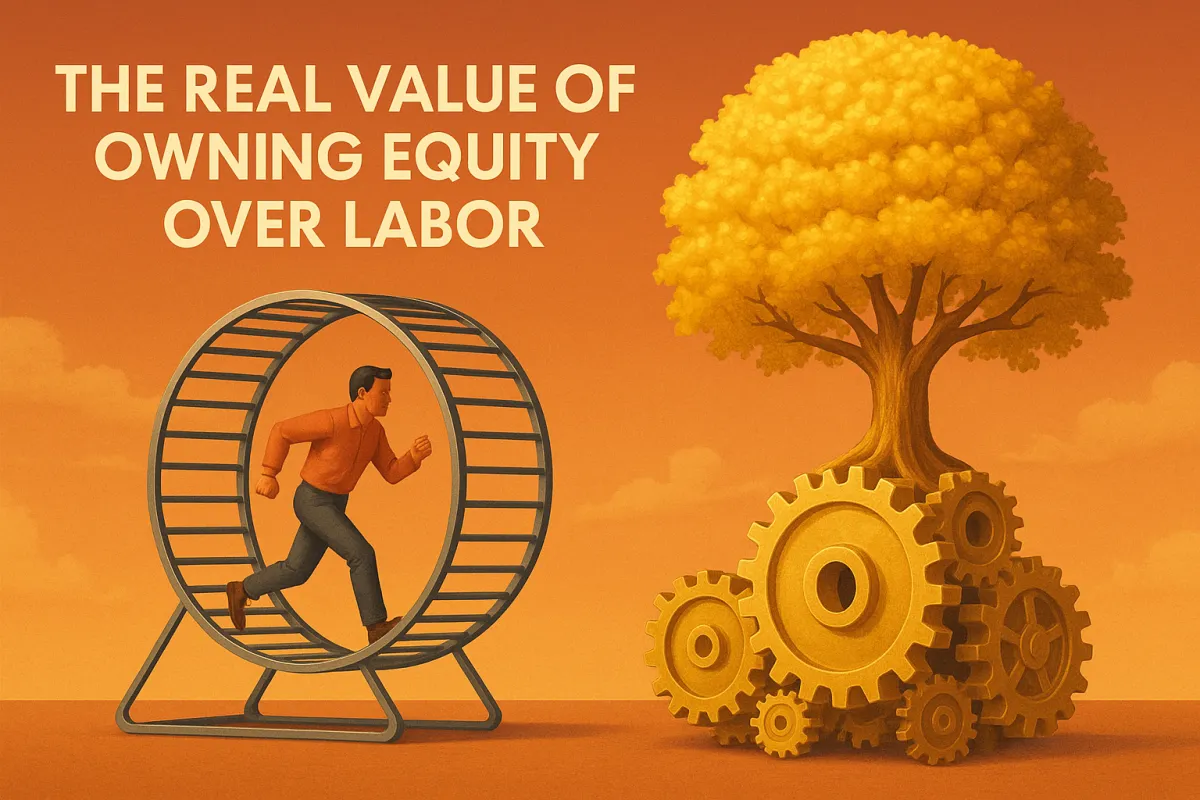
The Real Value of Owning Equity Over Labor
Last Updated: November 6, 2026
Quick Answer:
Equity is an ownership interest, while labor is work performed for compensation. Ownership can offer a share of future value or profits, but can also lose value and require ongoing work, capital, and oversight. Earned income and ownership can complement each other. Neither is a measure of a person’s worth or faithfulness.
Understand Ownership Without Dismissing Work
People grind for decades.
They stay busy.
They stay reliable.
They stay loyal.
And after thirty years they look up and realize something painful:
They do not own anything that pays them back.
They traded every hour for a dollar, but never built a machine that produces dollars without them.
At Greatness Gained, ownership is a stewardship decision, not an escape from the dignity of work. Ephesians 4:28 connects honest labor with having something to share with people in need. That gives earning a purpose beyond status. Someone providing for a household through a job is not living a lesser life than a business owner.
Work more hours.
Work harder.
Work longer.
Work until you cannot.
Then hope something magical happens later.
But nothing magical ever happens.
Earned income can fund savings, investments, and other long-term goals. Whether wealth accumulates depends on income, expenses, circumstances, and choices, not simply whether someone is called an employee or an owner.
Ownership may broaden your options, but it is not a promise of security or control. First understand what you would own, what it costs, and what could go wrong.
Use the comparison below to ask better questions about ownership alongside paid work.
1. Paid Work and Ownership Produce Different Claims on Income
Labor produces income only while you are actively doing the work.
You work the hour.
You get paid once.
The job is done.
The income stops.
This is why most people feel trapped.
But equity is different.
Ownership can entitle you to distributions or a sale value if the asset performs and the governing terms allow it. There may be no distribution, and a sale may be difficult or impossible.
Examples:
A business may generate recurring revenue while still needing management, staffing, and reinvestment.
A rental property may collect rent while also facing vacancies, repairs, financing costs, and management work.
Software may earn subscription revenue while needing maintenance, support, hosting, and continued customer demand.
A digital product may be sold more than once, but sales, updates, and delivery are not automatic.
Equity multiplies the impact of each hour you invested.
Labor gives you a paycheck.
Equity gives you a pipeline.
2. Ownership Changes the Relationship Between Time and Returns
Labor is limited by:
Energy
Time
Health
Hours in a day
Your boss
Your industry salary cap
Even if you are the hardest worker in the world, you cannot work more than 24 hours in a day.
Labor scales linearly:
Work more hours
Earn more money
Work fewer hours
Earn less money
Ownership returns face different limits, including demand, capital, costs, competition, and execution.
A business might grow when:
You build something once
Its product remains useful and its delivery and economics support additional customers
This is why wealthy people focus on owning assets, businesses, and systems.
Growth can increase obligations as well as income. More customers may require more staff, systems, working capital, or support.
Some returns may be less directly tied to your current hours, but they still depend on underlying economic activity and can fall or stop.
3. Compare Different Forms of Dependence
Labor depends on:
An employer
A client
A schedule
Market hours
Your ability to physically work
An interruption can affect employment or contract income, although the effect depends on pay arrangements and available protections.
Ownership may offer greater discretion in some settings, but the amount depends on your rights and obligations. Consider potential changes in:
Control
Autonomy
Optionality
Freedom to choose how you spend your time
When you own:
A business
A profitable online system
A portfolio of content
A micro SaaS tool
A rental property
A recurring subscription product
A training program
A piece of intellectual property
an ownership interest may diversify income, or concentrate it in one business, market, tenant, customer group, or platform. Do not assume it removes dependence on others.
You gain control over your financial life.
4. Both Work and Ownership Can Serve Real Needs
Labor says:
“I will give you my time if you pay me.”
Equity says:
“I will create something valuable, and people will pay the system, not me.”
This shift is everything.
Skilled workers also sell judgment, expertise, and useful results. Owners and workers can both help solve problems.
When you earn through equity, you sell:
Solutions
Speed
Clarity
Convenience
Access
Expertise
Results
Transformations
You solve problems at scale rather than working hours at scale.
Price and compensation depend on demand, bargaining power, skill, competition, and other conditions. A larger financial reward is not evidence of greater moral value. James 5:4 condemns withholding workers’ pay. If you become an owner, fair treatment and paying what you owe belong in the operating plan.
5. Labor Builds Income. Equity Builds Wealth.
Income pays your bills.
Wealth changes your life.
Wealth allows you to:
Take risks
Buy assets
Invest in yourself
Move cities
Start new ventures
Protect your family
Retire early
Choose how you spend your days
Wealth is built from:
Ownership
Leverage
Automation
Assets
Cashflow
Appreciation
Value you created one time
Wages and professional income can build savings and fund ownership. Equity is only one form of an asset, and an asset may produce a loss.
Compounding is possible when positive returns are retained or reinvested, but it is not automatic. Investor.gov explains that stock represents company ownership and that investors can lose money. Dividends and rising prices are not guaranteed.
6. Plan for Income Interruptions in Either Model
Labor stops paying when life happens:
When you get sick
When you get injured
When you are burned out
When you have family emergencies
When you want time off
When you need rest
Ownership income can also stop, including during a period when you are unable to work.
A well-run arrangement may continue operating during an absence, but check who handles delivery, emergencies, and decisions:
While you sleep
While you are on vacation
While you recover
While you take a break
While you spend time with family
While you focus on other projects
Proverbs 27:23-24 connects attentive care of resources with the recognition that riches do not last forever. Apply that by reviewing actual costs, cash needs, and operational weaknesses. Resilience comes from preparation and resources, not the ownership label alone.
Labor creates insecurity.
Equity creates resilience.
7. Equity Gives You Leverage
Leverage means you can do more without working more.
Equity gives you leverage through:
Technology
Automation
People
Systems
Distribution
Intellectual property
Marketing
Capital
For example:
A video can reach additional viewers, though distribution, revenue, moderation, and platform dependence affect the result.
Serving more software customers may require more infrastructure and support. Check the additional cost and workload.
A larger membership may need additional moderation, customer care, and delivery capacity.
A business may delegate work to employees while the owner remains responsible for management and fair compensation.
Labor is effort based.
Equity is leverage based.
Leverage is how you multiply outcomes without multiplying hours.
8. Ownership May Form Part of a Legacy
Labor disappears the moment the work stops.
Some ownership interests can be transferred and remain valuable after an owner’s death. Others decline, are restricted, or depend heavily on that person.
This is why people pursue:
Buyable businesses
Recurring revenue streams
Intellectual property
Assets
Investments
Equity becomes:
A legacy
A safety net
An inheritance
A wealth engine
Proverbs 13:22 presents concern for later generations. It does not promise that any investment will become an inheritance. Skills passed on, care provided, generosity, and trustworthy conduct also shape a legacy. Get appropriate professional help for the legal and tax details of transferring assets.
9. Ownership Is One Possible Route to More Options
Changes that may improve someone’s options include:
Raises
Promotions
Overtime
Side jobs
More hours
Flexible work, lower expenses, savings, shared responsibilities, and ownership may all affect available time. The right mix depends on the household.
Depending on the arrangement, ownership might help you:
Work fewer hours
Work when you want
Choose your projects
Build instead of grind
Focus on strategy instead of labor
Spend time with the people you care about
First Timothy 6:17-19 warns against putting hope in uncertain wealth and calls for generosity. Do not make ownership the condition for peace or identity. Evaluate whether an opportunity supports your responsibilities and capacity to give, rather than merely promising status as an owner.
10. You Can Start Building Equity Even If You Are Starting From Zero
Different ownership paths need different resources. Some begin with modest cash, but all need some combination of time, skill, money, or access.
Money
Investors
A team
A huge audience
A perfect idea
These are possible assets or business projects to investigate, not equally accessible or equivalent investments:
Digital Products and Intellectual Property
Courses
Training programs
Subscription communities
Toolkits
Templates
Digital products
Paid newsletters
Interactive tools
Business Equity
Service business
Online coaching business
Local service business
Micro SaaS
Funnels and marketing systems
Content and Distribution Resources
YouTube channel
TikTok library
Email list
Website with organic traffic
Financial and Property Assets
Saving and investing
Rental units
Income producing assets
A course, email list, or channel is not the same as a share of company equity. Check what you actually own, including contractual rights and platform restrictions. Property equity usually refers to value less debt secured against it. Keep these meanings distinct when estimating value.
Frequently Asked Questions
Is labor bad?
No. Honest work has dignity. Ownership is optional and should fit your circumstances, not become a deadline or test of ambition.
How do I start if I have no experience?
Learn how the proposed asset earns money, what it costs, and how ownership rights work. Protect essential household needs and seek qualified advice before commitments you do not understand.
How long does it take to build equity?
There is no universal timeline or guaranteed return. Buying an ownership interest and building a profitable business are different tasks. Evaluate progress through records and actual results.
Do I need to quit my job to build equity?
No. Earned income and ownership can coexist. Do not assume a side project will replace wages, benefits, or the stability your household needs.
The Bottom Line
Paid work and ownership can each contribute to a household’s financial life. The goal is to use the resources available wisely, not rank people by how they earn.
Review cash needs, debt obligations, potential losses, and the time needed to manage any asset.
Diversification can reduce concentration risk, but cannot guarantee against losses. See Investor.gov’s diversification explanation.
Ownership may involve less direct delivery work while creating other responsibilities. Count both.
No single income model guarantees wealth, freedom, or control.
Investigate assets that fit a clear goal and risk capacity, without assuming they will keep paying indefinitely.
Key Takeaways
Labor trades hours for income
Ownership returns can rise, fall, or stop
Labor has a ceiling
Growth faces economic and operational limits
Ownership changes rather than removes dependencies
Some assets can transfer to later generations
Equity builds wealth
You can start small and grow
What To Do Next
Choose one ownership concept to study before committing money. Write down the rights, costs, ongoing work, downside, and how you could exit. Compare it with continuing to earn and save. Pray, seek informed counsel, and reject any pitch that treats uncertainty as a lack of faith.
Stewardship means caring for what is entrusted to you and the people affected by your decisions. You can practice it as a worker, owner, investor, or a combination of those roles.
Mail
Facebook
LinkedIn
X
Pinterest
Reddit
Snapchat