
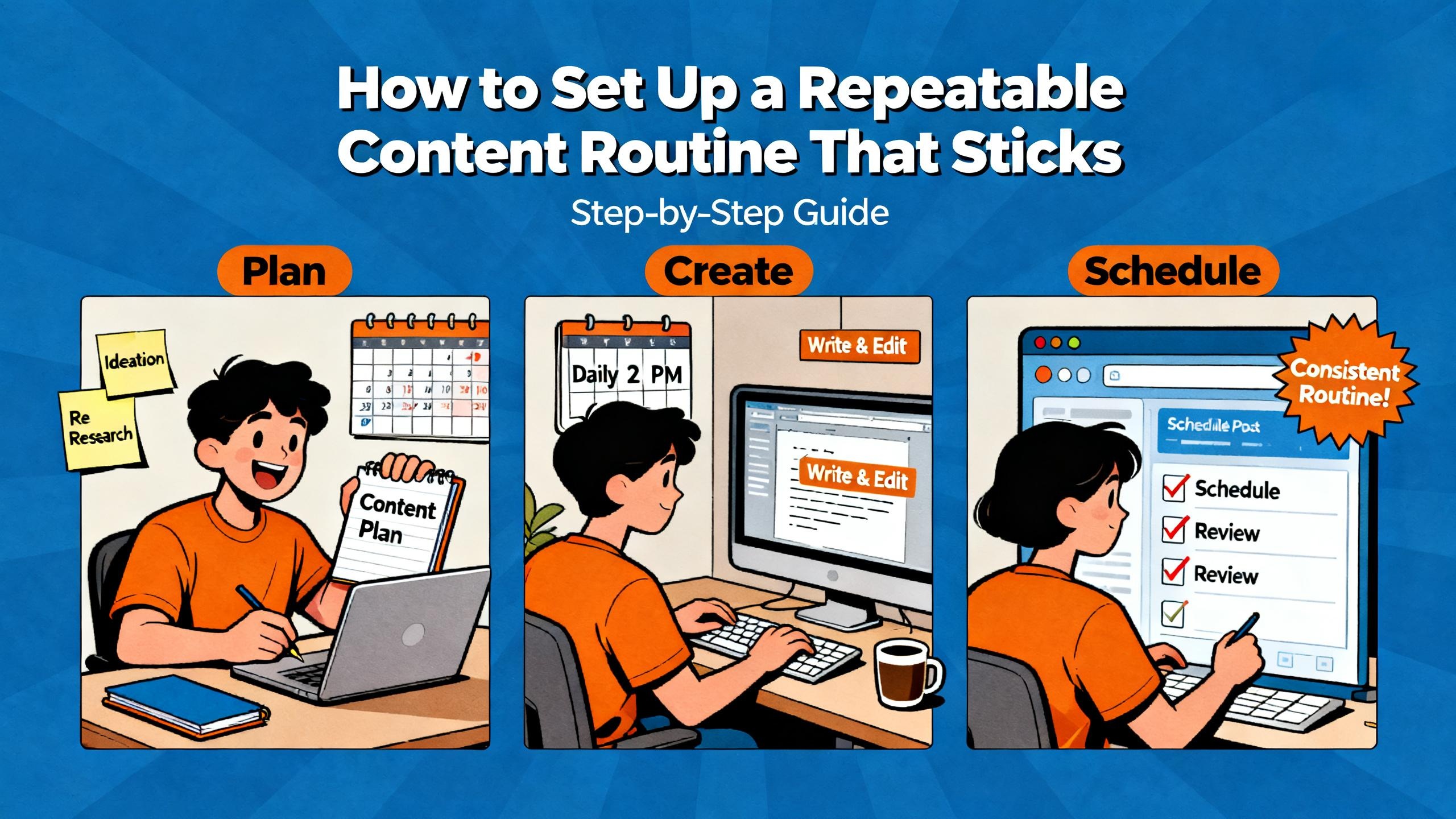
How to Set Up a Repeatable Content Routine That Sticks
Last Updated: January 5, 2026
Quick Answer
A repeatable content routine sticks when it removes friction, simplifies your workflow, limits decision making, assigns clear tasks to specific days, and makes the process easy to execute even on low energy days. The routine must be structured enough to guide you and flexible enough to follow consistently.
Creators struggle with consistency not because they lack ideas, motivation, or passion. They struggle because they lack a repeatable routine. They wake up every day guessing what to make, how to make it, and when to make it. That guessing drains their energy long before the actual creation begins.
A routine removes that guessing. A routine gives you momentum. A routine turns creativity into a system instead of a spontaneous event. When you have a repeatable content routine, you no longer rely on motivation. You rely on structure. And structure produces consistency.
The goal is not to find a magical workflow. The goal is to create a routine so easy, clear, and predictable that you can follow it even when you feel tired, busy, or uninspired.
This article gives you the exact method for building a content routine that sticks long term. Not for one week. Not for a month. A routine that becomes your natural way of operating.
Why Most Creators Fail to Build a Routine
There are predictable reasons why creators fail to create a repeatable content rhythm. These reasons have nothing to do with talent.
Here are the real causes.
1. They make the routine too complicated
Complexity feels exciting at first but collapses under real life pressure. A routine must be simple enough to survive imperfect days.
2. They change their process too often
Creators jump from one method to another because they feel behind. No method works without consistency.
3. They rely on inspiration instead of structure
Inspiration is unreliable. Systems give you consistency even when you do not feel creative.
4. They do not schedule the routine
If the routine has no home on your calendar, it becomes optional. Optional routines disappear quickly.
5. They do not track progress
What you track improves. What you ignore fades.
These problems do not come from lack of discipline. They come from lack of design. A routine that is not designed to be simple, predictable, and repeatable will eventually break.
The Three Components of a Routine That Sticks
A routine sticks when it has three components.
A structure you can repeat
A workflow you can follow
A schedule you can maintain
If any of these pieces are missing, the routine fails. When all three are in place, you gain consistency and momentum.
Let’s break each one down.
Component One: A Structure You Can Repeat
Structure is the foundation of your content routine. A repeatable routine is built on patterns, not randomness. You need a pattern for what you create, when you create it, and how you create it.
Your structure should tell you:
• What type of content you make each day
• What platform each piece is created for
• What time block you use for creation
• What steps you follow from idea to publication
A strong structure looks the same every week. The details change. The topics change. But the structure stays stable.
Why Structure Works
Structure reduces decision fatigue. It tells your brain exactly what to do. When the process is predictable, you do not burn energy trying to figure out your next step.
Structure is the difference between a creator who produces reliably and a creator who produces randomly.
Component Two: A Workflow You Can Follow
A workflow is a sequence of steps that takes your content from idea to finished product. Without a workflow, you improvise every time. Improvisation wastes time and creates inconsistency.
A workflow should include the following steps:
Collect ideas
Select topics
Outline your content
Draft
Edit
Publish
Track performance
When you repeat this workflow, you become faster, clearer, and more efficient. Your brain learns the pattern. Your skills sharpen. Your process becomes natural.
Why Workflow Matters
A workflow prevents creative overwhelm. When you always know what comes next, you eliminate hesitation. You eliminate chaos. You eliminate the feeling of being lost in your process.
Workflows turn creativity into a predictable engine instead of a constant battle.
Component Three: A Schedule You Can Maintain
A routine becomes real when it becomes scheduled. If your content creation has no assigned time, it competes with everything else in your life. And everything else will win.
A schedule should be:
• Specific
• Predictable
• Protected
• Realistic
Most creators overschedule and then collapse. You want a schedule that you can follow even on difficult days.
Why Scheduling Works
Scheduling gives your routine a physical place in your life. It is no longer an idea. It is a commitment. When you give your routine a home, it becomes a habit.
The Repeatable Content Routine Framework
This framework gives you the exact steps to set up a routine that sticks. Use it as your blueprint.
Step 1: Choose Your Content Frequency
Most creators start by asking how much content they should post. This is the wrong question. The correct question is:
How much content can I post consistently for the next 12 months?
Consistency is better than intensity.
Start with a frequency that feels achievable even during your busiest weeks.
Examples:
• Three short form videos per week
• One long form piece per week
• Daily posts on one platform
• Weekly newsletter
Choose a frequency you can sustain. You can always increase later.
Step 2: Assign Content Types to Specific Days
You need theme days. Theme days turn your workflow into a predictable pattern.
Example:
• Monday: Script writing
• Tuesday: Recording
• Wednesday: Editing
• Thursday: Publishing
• Friday: Analytics and improvement
Theme days reduce decision making. You know exactly what each day is for.
Step 3: Break Each Day Into Simple Action Blocks
An action block is a single unit of work. These blocks keep your routine easy and doable.
Example of a scripting block:
Choose one topic
Write three bullets
Expand the bullets into a script
Example of a recording block:
Set up your equipment
Record three videos
Save all files to your content folder
Action blocks prevent overwhelm by giving you one clear target.
Step 4: Build a Weekly Content Pipeline
A pipeline ensures that every day moves your content a little further along.
Example:
• Monday: Ideation
• Tuesday: Drafting
• Wednesday: Recording
• Thursday: Editing
• Friday: Publishing and reviewing
This pipeline creates forward motion. You are always building something for the next stage.
Step 5: Use Templates to Speed Up Repetition
Templates reduce friction and save time.
You can create templates for:
• Scripts
• Hooks
• Outlines
• Thumbnails
• Captions
• Calls to action
• Platform formats
When the structure is prebuilt, all you need to do is fill in the content. Templates are one of the easiest ways to make your routine stick.
Step 6: Protect a Non Negotiable Content Block
This is the part most creators ignore. You must choose a block of time each day or each week that is protected from everything else.
This block is your creation time. It is not optional. It is not negotiable. It is not flexible.
If you only follow one rule, follow this rule.
When you protect your creation time, your routine becomes a natural part of your identity.
Step 7: Track the Routine, Not the Results
Creators often quit because their results are slow. Results are slow at first for everyone. What matters most is whether you follow the routine.
Track:
• Did I complete the day’s block
• Did I follow the workflow
• Did I execute my theme day
• Did I use my templates
• Did I publish on schedule
When you track the routine, the results eventually catch up. The routine drives the outcomes.
Why This Routine Stays Sustainable
Sustainability comes from reducing friction. A routine sticks when it feels easy to follow.
Here is why this structure lasts.
1. It has predictable patterns
Your brain likes repetition. Repetition becomes habit.
2. It reduces daily choices
Less decision making means more energy for creation.
3. It uses simple blocks
Simple blocks are easier to complete than long sessions.
4. It is flexible without losing structure
You can adapt the content, but the routine stays identical.
5. It builds momentum through consistency
Success comes from accumulation, not intensity.
When a routine is simple and supportive instead of demanding and chaotic, it stays in your life long term.
A Seven Point Checklist for a Content Routine That Sticks
Use this checklist each week to confirm your routine is working.
1. Is my frequency sustainable
2. Do I have theme days
3. Are my action blocks simple
4. Am I following my pipeline
5. Are my templates complete
6. Is my content block protected
7. Am I tracking consistency
If all seven points are yes, your content routine is strong.
Conclusion
A repeatable content routine is not built on inspiration. It is built on structure. When you remove the friction from creation, you gain consistency. When you gain consistency, your skills increase. When your skills increase, your results compound.
The creators who succeed long term are not the most talented. They are the most structured. They follow a routine that protects their creativity, preserves their energy, and guides their actions.
Build your routine once. Practice it daily. Adjust it weekly. Protect it always. If you do that, your content output will become unstoppable.
Mail
Facebook
LinkedIn
X
Pinterest
Reddit
Snapchat