
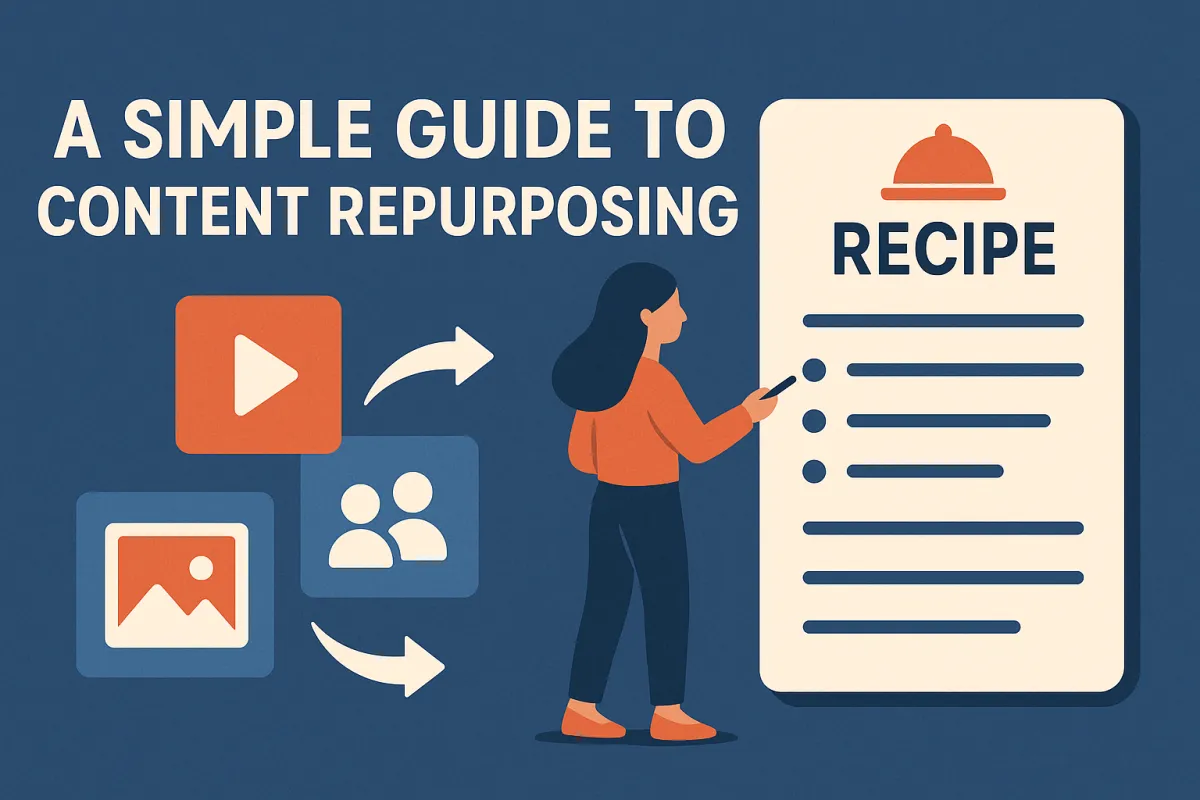
A Simple Guide to Content Repurposing
Last Updated: November 21, 2025
TL;DR
Content repurposing helps you turn one idea into many assets across multiple platforms so you can reach more people with less effort. Repurposing is not copying. It is transforming the same core idea into formats that fit each platform. This creates consistency, visibility, and audience growth without burnout.
Introduction: You Do Not Need More Ideas, You Need Better Repurposing
Most creators think the path to growth is producing endless new ideas.
They sit staring at blank screens, hoping to come up with something original every day. The pressure rises. The creativity drops. The consistency disappears.
The truth is simple.
You do not need more ideas.
You need to repurpose the good ideas you already have.
Content repurposing lets you maximize your output without increasing your workload. It helps you show up everywhere your audience is without stretching yourself thin.
This guide explains the simple way to repurpose content effectively so you can grow faster while working smarter.
Let us begin.
1. Start With a Core Piece of Content
Every repurposing system begins with one strong piece of content.
This could be:
A long form video
A podcast episode
A blog post
A live training
A case study
A webinar
A written framework
A story or example
Choose a core piece that contains enough depth and ideas to create multiple smaller pieces.
Think of the core content as the tree trunk. Everything else branches out from it.
2. Break the Core Content Into Micro Ideas
Your core piece contains multiple insights, examples, steps, stories, or beliefs. Each one can become a standalone content asset.
Break the core content into:
Key takeaways
Individual steps
Specific lessons
Mini stories
Quotes
Contrarian lines
Data points
Action items
Definitions
Mistakes
Beliefs
Visual frameworks
Each micro idea becomes a seed for a social post, email, short video, or graphic.
Repurposing begins with extraction.
3. Turn Each Micro Idea Into Platform Specific Formats
Different platforms require different content styles. Repurposing is about taking the same idea and reshaping it so it fits the context where it will be consumed.
Here is how you do it.
For TikTok and Reels
One idea per clip
Fast pacing
Clear hook
Short story or lesson
Simple CTA
For Instagram Posts
Carousel breaking down the micro idea
Short caption with a clear takeaway
Quote graphics
Before and after visuals
For YouTube Shorts
Short insight
Quick demonstration
High energy delivery
For Email
Story version of the micro idea
Lesson plus actionable step
CTA to deeper content
For LinkedIn
Structured insight
Professional angle
Real example from your business
For Twitter
One liners
Threads
Contrarian takes
For Blog Posts
Multiple micro ideas combined into a full article
Step by step breakdown
For YouTube Long Form
Combine clusters of micro ideas into topic buckets
Repurposing is not posting the same content everywhere. It is transforming one idea to match platform expectations.
4. Create Content Clusters That Feed Each Other
Clusters help you control your narrative.
A cluster is a group of posts built around the same topic.
For example, from one core video on content strategy, you could create:
A lesson about hooks
A mistake creators make
A story about a breakthrough
A step by step framework
A myth you debunk
A demonstration of a method
A quote from the video
A short reel from the video
An email built on a story
Clusters create narrative consistency and help your audience understand your authority more quickly.
When content connects, your brand feels stronger.
5. Use the Rule of Three for High Impact Repurposing
One idea should become at least three assets:
A short social video
A written version
A visual graphic or carousel
This helps you build omnipresence without increasing creation time. It also gives your audience multiple ways to absorb the same message.
Some people watch video.
Some people prefer writing.
Some people need diagrams.
Repurposing ensures your message reaches everyone in the format they prefer.
6. Repurpose in Layers Instead of All at Once
A simple method is to repurpose in layers:
Layer 1
Extract all micro ideas.
Layer 2
Turn each micro idea into short content.
Layer 3
Turn the best short pieces into long form content.
Layer 4
Turn long form content into systems, guides, or assets.
This layered approach ensures you get maximum leverage from every idea.
7. Use Templates to Make Repurposing Fast and Consistent
Templates remove the friction of starting from scratch.
Have templates for:
Carousels
Quote graphics
Short form scripts
Email outlines
Blog post structures
Framework visuals
Story layouts
Hook formats
Captions
CTAs
When your templates are ready, repurposing becomes an assembly line.
Templates increase speed and keep your content visually consistent across platforms.
8. Turn Evergreen Content Into Recurring Assets
Repurposing does not end after publishing. Evergreen content can be reused repeatedly.
Examples:
Monthly repost of high performing reels
Weekly share of your best carousels
Seasonal resurfacing of relevant stories
Reposting your top 10 threads
Resharing old blog posts
Turning long form videos into new clips each month
Your audience is always growing.
Most people never saw your old content.
Repurposing old material is not repetition. It is smart distribution.
9. Use Repurposing to Strengthen Your Core Message
The best creators repeat their core ideas until their audience fully understands and identifies with them.
Repurposing reinforces:
Your frameworks
Your values
Your beliefs
Your lessons
Your system
Your story
Your transformation
People do not remember a message they saw once.
They remember messages they see repeatedly in many forms.
Repurposing turns your message into a movement.
10. Repurpose for Multiple Awareness Levels
Not everyone in your audience is at the same stage.
Repurpose each micro idea for:
Awareness
Education
Objection removal
Demonstration
Transformation
CTA
Example:
Core idea: Why consistency matters.
Awareness version: A myth about consistency.
Education version: A step by step explanation.
Objection version: Why consistency is not discipline.
Demonstration version: A real example.
Transformation version: A story of someone improving.
CTA version: Here is the tool to help you stay consistent.
Repurposing across awareness levels multiplies conversions.
11. Build a Repurposing Workflow You Can Follow Weekly
A personal repurposing workflow might look like this:
Step 1
Record one long piece of content.
Step 2
Extract 10 to 20 micro ideas.
Step 3
Turn each micro idea into:
A short video
A written post
A graphic
Step 4
Schedule content across platforms.
Step 5
Turn the best performing ideas into emails or full blog posts.
Step 6
Turn clusters into downloadable resources or training modules.
Step 7
Review performance and refine.
The workflow repeats forever.
One idea becomes an entire week of content.
12. Repurpose to Build Authority, Not Just Volume
Repurposing is not about posting more.
It is about reinforcing your authority.
Authority grows when you:
Repeat core ideas
Teach consistently
Demonstrate your framework
Share real examples
Build narrative
Create clarity
Maintain presence
Repurposing ensures you remain top of mind even when you are focusing on other parts of your business.
Visibility builds trust.
Trust builds conversions.
Conclusion: Repurposing Lets You Do Less While Reaching More People
Content repurposing is not a shortcut. It is a strategy.
It helps you:
Multiply your output
Reduce creation pressure
Stay consistent
Strengthen your brand
Reinforce your ideas
Build authority
Reach more people
Increase conversions
Build a recognizable voice
You do not need to create more content from scratch.
You need to repurpose the content that already works.
When you master repurposing, the entire content creation process becomes easier, faster, and more effective.
This is how creators build omnipresence without burnout.
Mail
Facebook
LinkedIn
X
Pinterest
Reddit
Snapchat