
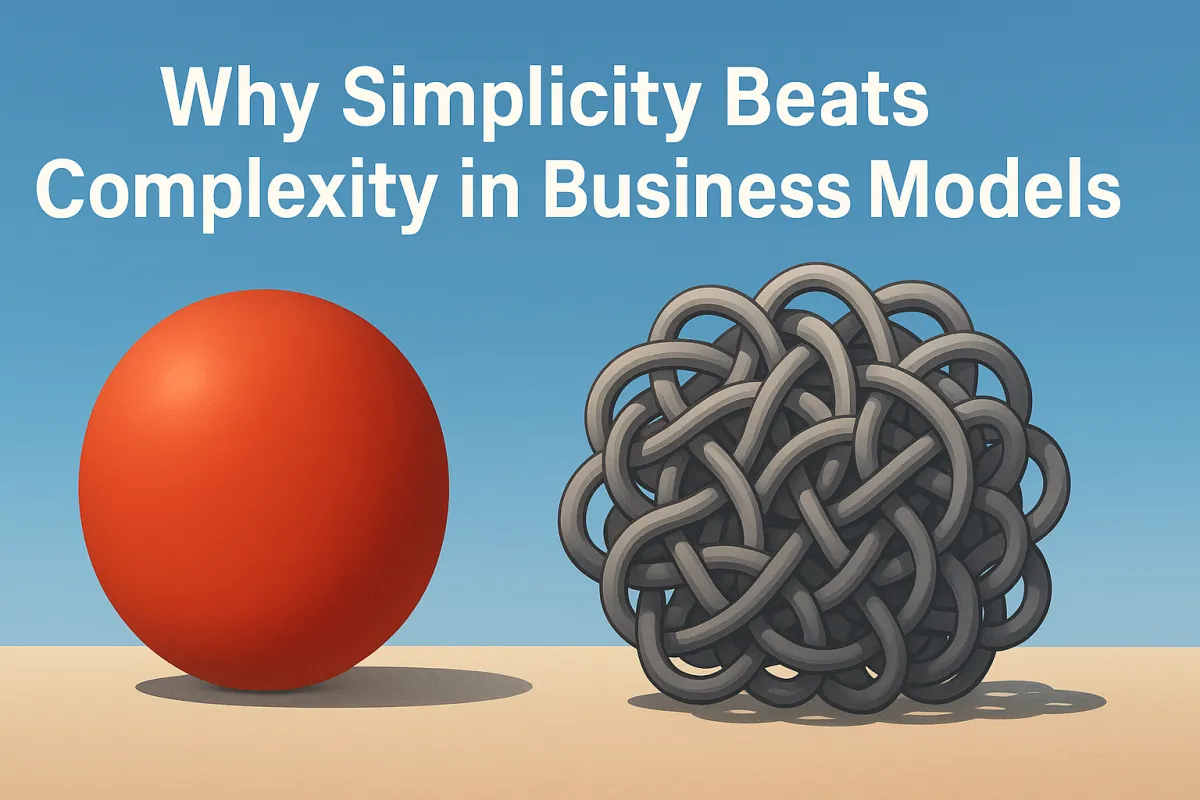
Why Simplicity Beats Complexity in Business Models
Last Updated: October 3, 2025
Quick Answer:
Simplicity beats complexity in business models because simple systems scale faster, fail less, cost less, and convert better. Complexity drains resources, slows momentum, increases errors, and hides the real drivers of profit. Simple businesses grow. Complex businesses collapse.
Complexity Is the Silent Killer of Good Businesses
Most struggling businesses do not fail because of lack of effort.
They fail because they are drowning in unnecessary complexity.
Entrepreneurs try to:
Sell to too many audiences
Build too many products
Offer too many services
Add too many steps
Chase too many opportunities
Automate too early
Build features nobody asked for
Layer tools on top of tools
Change direction constantly
This complexity creates confusion.
Confusion destroys momentum.
Complexity is the enemy of execution, the enemy of profit, and the enemy of clarity.
Simplicity is the antidote.
This guide breaks down exactly why simplicity always wins and how to build a simple model that grows predictably.
1. Simplicity Makes Decision Making Faster
Complex businesses require constant decisions:
Which product to focus on
Which segment to target
Which funnel to fix
Which offer needs attention
Which channel to prioritize
This leads to:
Overthinking
Delays
Mental fatigue
Analysis paralysis
Simple business models remove unnecessary decisions.
When you have:
One target audience
One core offer
One primary funnel
One main traffic channel
One conversion system
everything becomes easier.
You move faster because you do not have to evaluate 100 different paths.
You already know your path.
2. Simplicity Makes Your Message Clearer
People buy when they understand what you offer.
Most entrepreneurs fail because their message becomes diluted.
They try to talk to everyone.
They use vague language.
They switch positioning often.
They overcomplicate their pitch.
They confuse their audience.
Confused people do not buy.
Simple messaging creates:
Clarity
Relevance
Trust
Confidence
Examples of simple messaging:
“I help local businesses automate operations.”
“I help creators build daily content systems.”
“I help small business buyers evaluate deals.”
Clear beats clever.
3. Simple Offers Convert Higher Because Buyers Understand Them Quickly
Your offer is not judged on how innovative it is.
It is judged on how fast someone understands the value.
Complex offers:
Require explanation
Require education
Slow down buying
Increase objections
Create friction
Simple offers:
Show the outcome clearly
Feel easy to say yes to
Require less effort to deliver
Scale faster
Convert better
The easier your offer is to understand, the easier it is to sell.
4. Simple Businesses Are Easier to Operate Daily
Complex models require:
More tools
More team members
More integrations
More processes
More SOPs
More coordination
This increases:
Breakdowns
Mistakes
Miscommunication
Stress
Expenses
Simple businesses can run smoothly even when:
You are tired
You are distracted
You are short staffed
You are busy
Operational simplicity is operational freedom.
5. Simplicity Reduces Expenses and Increases Profit
Complexity is expensive.
It creates hidden costs:
Software
Contractors
New hires
Consultants
Maintenance
Tech stacks
Time loss
Simple models focus on:
Profit drivers
Lean operations
Efficient tools
Predictable workflows
When your model is simple, more revenue becomes profit.
You do not need a big machine.
You need a focused machine.
6. Simple Models Scale Faster
Scaling does not require:
More products
More complexity
More funnels
More offers
Scaling requires:
One offer that works
One funnel that converts
One traffic source that is predictable
When you scale a simple model, everything multiplies cleanly.
When you scale a complex model, everything breaks.
Simple businesses can grow without their systems collapsing.
7. Simplicity Eliminates Failure Points
Complex systems have more ways to fail.
Every component introduces:
Another link
Another dependency
Another risk
Another potential breakdown
Simple systems have fewer moving parts.
Fewer moving parts mean:
Fewer errors
Fewer emergencies
Fewer customer issues
Fewer internal problems
Fewer opportunities for things to go wrong
Simplicity creates stability.
8. Simple Businesses Deliver a Better Customer Experience
The simpler your process is, the easier it is for your customers to succeed.
Complex customer journeys:
Confuse buyers
Create frustration
Make onboarding difficult
Require more support
Slow progress
Simple customer journeys:
Are easy to follow
Are enjoyable
Build confidence
Deliver outcomes faster
A simple customer experience produces better testimonials, better retention, and better referrals.
9. Simplicity Helps You Focus on What Actually Works
When your business is simple, you can clearly see:
What drives revenue
What customers love
What improves results
What needs optimizing
What needs removing
Complex businesses hide the truth.
When you have too many moving parts, you cannot tell:
What is broken
What is working
Where the bottlenecks are
Simplicity creates visibility.
Visibility creates improvement.
10. Simple Businesses Require Less Stress and Fewer Hours
Most entrepreneurs are exhausted not because the business is hard, but because the business is complicated.
Simplifying your model reduces:
Stress
Burnout
Decision fatigue
Rework
Busywork
Simple businesses give you more:
Time
Freedom
Control
Enjoyment
Flexibility
Simplicity scales your peace as much as it scales your revenue.
11. Complexity Comes From Fear. Simplicity Comes From Confidence.
People add complexity because they fear:
Missing out
Losing customers
Not being enough
Not sounding impressive
Not having enough features
Not being competitive
This fear creates bloated business models.
Confident entrepreneurs strip away what is unnecessary.
Simplicity is a sign that you believe in:
Your offer
Your process
Your audience
Your positioning
Your long term direction
Confidence removes everything that does not matter.
12. Simplicity Lets You Become Exceptional at the Few Things That Matter
Great businesses are not great at everything.
They are exceptional at a few important things.
You cannot be exceptional when your attention is scattered across:
Ten funnels
Twelve offers
Eight customer segments
Five traffic sources
A dozen workflows
You become exceptional by narrowing your focus.
Simplicity gives you that focus.
Frequently Asked Questions
Is simplicity always better than complexity?
Yes, unless complexity is necessary for value creation. Most complexity is optional and harmful.
Does a simple business model limit growth?
No. A simple business model actually scales faster because you can double down on what works.
Can I sell multiple offers and still be simple?
Yes, if they are aligned and built on one core transformation.
Does simplifying mean doing less work?
It means doing the right work. Quality beats quantity.
The Bottom Line
Complexity is not a sign of sophistication.
It is a sign of distraction.
If you want:
Faster growth
Fewer headaches
Higher profit
Better customer satisfaction
More clarity
More momentum
you must simplify your business model.
Simplicity creates:
Focus
Speed
Stability
Profitability
Scalability
The businesses that win long term are the ones that stay simple long enough to become truly great.
Key Takeaways
Complexity slows progress
Simplicity increases clarity
Simple offers convert better
Simple operations scale easier
Complexity increases costs
Simplicity drives profit
Simple systems reduce failure
Confidence creates simplicity
What To Do Next
Audit your current model.
Remove everything non-essential.
Simplify your offer.
Simplify your funnel.
Simplify your traffic strategy.
Simplify your operations.
Simplify your messaging.
Do less, but do it exceptionally well.
Mail
Facebook
LinkedIn
X
Pinterest
Reddit
Snapchat