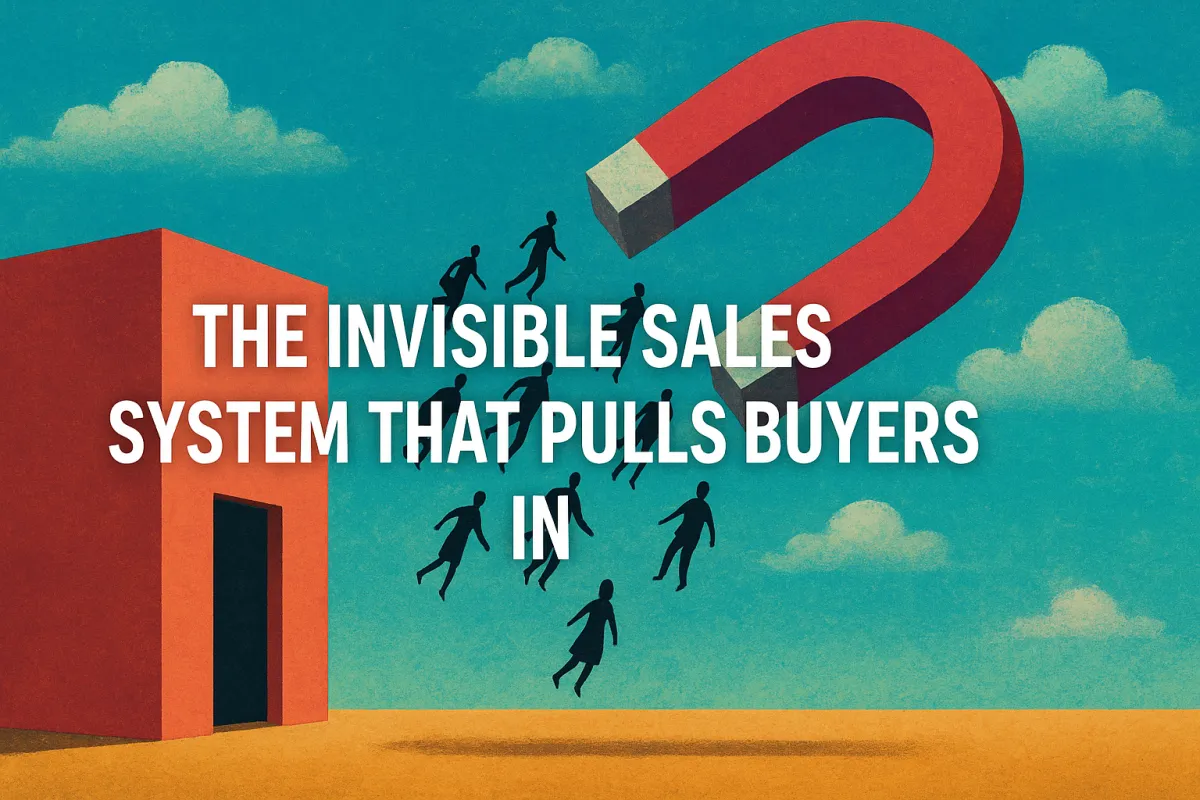
The Invisible Sales System That Pulls Buyers In
Last Updated: August 22, 2025
Quick Answer:
An invisible sales system pulls buyers in by educating them, demonstrating value before the pitch, solving problems upfront, using content as the sales engine, building trust through consistent touchpoints, and guiding people toward a natural buying decision without pressure. It sells by showing instead of telling, helping instead of pushing, teaching instead of chasing.
Why You Need A Sales System That Works Even When You Are Not Selling
Most entrepreneurs think the only way to grow revenue is to push harder.
More outreach.
More pitching.
More calling.
More follow up.
More pressure.
But there is a smarter way.
A healthy business does not chase buyers.
A healthy business attracts buyers.
An invisible sales system works in the background.
It warms up strangers.
It builds trust.
It turns curiosity into desire.
It creates demand before you ever present an offer.
It sells for you.
Quietly.
Consistently.
Predictably.
If your sales depend on you being “on” every day, you do not have a business.
You have a treadmill.
This article reveals the invisible sales system that pulls buyers in so your business grows even when you are offline.
1. The Core Principle: People Buy When They Understand, Not When They Are Pressured
Most people misunderstand why buyers say yes.
They think:
A better pitch
A clever script
More persuasion
More hype
will close the deal.
In reality, buyers say yes when:
The problem is obvious
The solution is clear
The outcome feels believable
The path feels simple
The risk feels low
The guide feels trustworthy
Your job is not to close people.
Your job is to make the decision easy.
The invisible sales system removes friction so buyers close themselves.
2. The Invisible Sales System Has Three Jobs
A real sales system only needs to do three things:
Job 1: Clarify the problem better than the buyer can describe it
If they feel understood, they trust you.
If they trust you, they buy from you.
Job 2: Show the mechanism that makes your solution work
This is the moment when they say:
“I finally get it.”
This is the moment demand is created.
Job 3: Prove you can get them where they want to go
You show examples, stories, explanations, and frameworks that build absolute belief.
Once these three jobs are done, the sale feels like the next logical step.
The invisible sales system is about making the path obvious.
3. The Psychology Behind Invisible Selling
Invisible selling works because it aligns with human behavior.
Buyers want:
Certainty
Clarity
Confidence
Control
Safety
Understanding
They do not want:
Pressure
Force
Manipulation
Uncertainty
Guessing
An invisible sales system gives them the environment to make a confident decision without feeling chased.
It uses psychology in four key ways:
1. Micro Trust Builders
Small moments of value that make people say:
“This person gets it.”
2. Repetition of the Core Message
The message becomes more believable every time they encounter it.
3. Demonstration Instead of Explanation
Showing is always more persuasive than telling.
4. Emotional and Logical Alignment
People buy emotionally.
They justify logically.
You provide both.
This is why invisible sales outperform traditional selling.
They feel natural.
4. Step One: Build Your Demand Engine
The demand engine is the front of your invisible sales system.
Its purpose:
Turn cold strangers into warm, informed, problem aware buyers.
It does this through value based content built around three pillars:
Pillar 1: Education Content
Teach them something meaningful.
Show them the problem they are stuck in.
Examples:
“Why you are not getting clients even though you post daily”
“How small business owners leak money without realizing it”
Pillar 2: Insight Content
Provide new perspectives that make old strategies obsolete.
Examples:
“You do not need more traffic. You need better retention”
“Your offer is not the problem. Your positioning is”
Pillar 3: Demonstration Content
Show behind the scenes of how your system works.
Examples:
“How I build a simple onboarding workflow that saves hours each week”
“Here is how we structure lead nurture sequences that convert quietly”
Demand is created by clarity, not volume.
When your content demonstrates understanding, buyers naturally move closer.
5. Step Two: Use Soft Capture Points Instead of Hard Funnels
Hard funnels feel like traps.
Soft capture points feel like upgrades.
A soft capture point is anything that invites someone deeper into your world without force.
Examples:
A free tool
A mini guide
A calculator
A short training
A cheat sheet
A script
A simple template
These work because they deliver immediate value.
High value free tools build more trust than any pushy funnel.
When the user gets something useful instantly, they believe you can help them further.
Your invisible sales system uses soft capture points to move people automatically from:
Cold
To warm
To interested
To buying
without pressure.
6. Step Three: Build a Warm Up Sequence That Sells Before Selling
Once someone enters your world, you guide them through a simple journey that prepares them to buy.
Your warm up sequence should contain:
1. An Introduction Email
Who you help, what you do, why it works.
2. An Insight Email
Break a myth or false belief.
3. A Value Delivery Email
Solve a small part of their problem.
4. A Mechanism Email
Reveal your unique process or system.
5. A Proof or Case Study Email
Show real results, even small ones.
6. A Soft Pitch Email
Invite them to explore your offer without pressure.
This sequence converts silently.
It creates belief.
It reduces resistance.
It builds readiness.
Your warm up sequence is the heartbeat of your invisible sales system.
7. Step Four: Create a Sales Asset That Converts Without Pressure
Most people have weak sales assets.
They rely on:
Short product descriptions
Weak landing pages
Unclear pricing
Missing explanation
No mechanism
No emotional connection
Your invisible sales system needs a long form sales asset that explains everything clearly.
This can be:
A long form sales page
A video sales letter
A webinar
A deep dive training
A behind the scenes demonstration
The purpose of the sales asset is not to hard sell.
The purpose is to:
Demonstrate the mechanism
Show the transformation
Explain how the offer works
Make the decision easy
Great sales assets reduce questions and increase conversions.
When done correctly, buyers feel like the offer is the obvious solution they have been searching for.
8. Step Five: Create a Low Friction Call To Action
Your CTA can make or break your invisible sales system.
A low friction CTA:
Asks for one simple step
Creates no pressure
Keeps the decision easy
Matches the buyer's readiness
Examples:
“Watch this demo”
“Get the guide”
“Start the trial”
“Join the next session”
“See how it works”
High friction CTAs like “Book a call now” or “Buy today” still work, but they must come after enough trust has been built.
Your CTA must feel like an invitation, not a demand.
9. Step Six: Use Follow Up That Feels Personal, Not Automated
Follow up does not mean nagging people.
Real follow up:
Answers concerns
Provides clarity
Helps decision making
Builds human connection
Invisible sales systems use follow up that feels personal, but is automated.
Examples:
“Here is the checklist people use before joining”
“Here is how the process works behind the scenes”
“Here are common questions new members ask”
These follow ups reduce fear and increase readiness.
When people feel safe, they buy.
10. The Big Lie: You Need to Be a Natural Salesperson
You do not need to be charismatic.
You do not need to be persuasive.
You do not need to be loud.
You do not need to be a closer.
You need:
A clear problem
A clear method
A clear outcome
A clear process
A clear message
Invisible sales systems sell through clarity, not personality.
Frequently Asked Questions
Does this work for any business?
Yes. Coaching, consulting, services, digital products, SaaS, local businesses, and agencies all benefit from invisible sales systems.
Does an invisible sales system replace traditional selling?
It reduces how much manual selling you need to do. Many buyers will purchase without ever speaking to you.
How long does it take to build?
Most systems can be built in one to two weeks.
Can beginners use invisible selling?
Yes. It is easier than traditional sales because it relies on value, not pressure.
The Bottom Line
The invisible sales system works because it sells the way people actually buy.
If you can:
Educate
Demonstrate
Show the mechanism
Provide value
Build trust
Remove friction
Use soft invitations
your business will grow naturally, predictably, and quietly.
You stop chasing.
You stop pushing.
You stop begging.
And people start coming to you.
This is how real businesses scale.
This is how great brands grow.
This is how demand is created.
Key Takeaways
Sales happen when buyers feel understood
Your content must educate and demonstrate
Soft capture points build deep trust
Warm sequences create readiness
Sales assets provide clarity
Low friction CTAs increase conversions
Invisible sales pull buyers in naturally
What To Do Next
Create one soft capture point.
Write a simple warm up sequence.
Record one long form sales asset.
Share content that demonstrates value.
Build your invisible sales system piece by piece.
Then let it work for you.
Mail
Facebook
LinkedIn
X
Pinterest
Reddit
Snapchat