
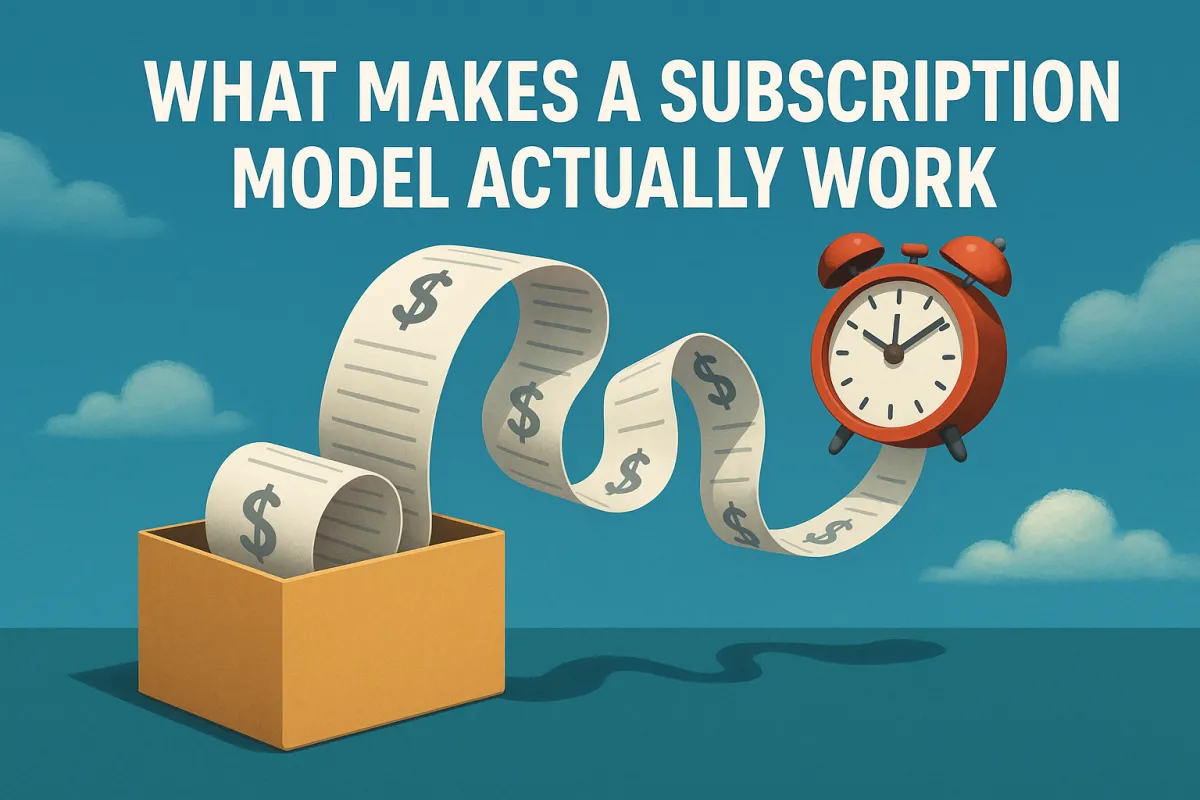
What Makes a Subscription Model Actually Work
Last Updated: October 12, 2025
TL;DR
A subscription model works when it delivers consistent value, solves an ongoing problem, builds habits, and creates predictable outcomes for the customer. Retention, not acquisition, drives growth. The subscription succeeds only when people feel they cannot afford to cancel because the value is clear, constant, and compounding.
Introduction: Why Some Subscriptions Explode While Others Collapse
Subscriptions look simple from the outside. Charge a monthly fee, deliver something, and enjoy recurring revenue. But most subscriptions fail quickly because they rely on hype instead of usefulness, content instead of outcomes, and novelty instead of habit.
A real subscription is not a product.
It is a system.
It is a relationship.
It is a promise that resets every 30 days.
People stay when they receive value that continues to matter.
People cancel when the value slows down, stacks up, or becomes irrelevant.
This guide breaks down the mechanics of why subscription models work in the real world and how you can build one that grows consistently, retains customers, and compounds revenue month after month.
Let us break down the foundation.
1. A Subscription Works When It Solves a Recurring Problem
One time problems create one time purchases.
Ongoing problems create ongoing revenue.
The first question any subscription must answer is simple:
What recurring problem am I solving
Examples include:
Fitness goals that require ongoing accountability
Businesses that need consistent leads
Households that need constant supplies
Creators needing regular content or tools
Local businesses needing scheduling, reminders, or follow ups
Professionals needing constant training or insights
Entrepreneurs needing support and community
Subscriptions work when the problem never fully ends.
Customers stay because the pain returns every month and your solution eases it every month.
If the problem disappears, the subscription disappears.
This is why the best subscription ideas are built around ongoing needs, not short term desires.
2. The Value Must Be Consistent, Not Occasional
Most subscriptions die because the value comes in waves.
If the value is unpredictable, customers cannot justify the cost.
If the value is consistent, customers treat the subscription like infrastructure.
Consistency comes from:
Weekly or monthly deliverables
Regular updates or new assets
Predictable support
Fresh content or tools
Ongoing improvements
A rhythm the customer can rely on
People cancel subscriptions that feel stale.
People keep subscriptions that feel alive.
The product should evolve over time.
It should get better, not bigger.
Customers should feel progress without ever feeling overwhelmed.
3. The Subscription Must Create a Habit or Routine
Habit drives retention.
When your subscription becomes part of a customer's weekly workflow, daily routine, or monthly planning, cancellation becomes harder because it disrupts their life.
Habit is created by:
Predictable delivery schedules
Daily or weekly interactions
Rituals connected to using your product
Systems that depend on your tools
Dashboards they check often
Communities they engage with
Appointments or calls that provide accountability
A subscription without a habit is a temporary purchase.
A subscription with a habit becomes essential.
People stop canceling when your product becomes part of their identity and routine.
4. The Outcome Must Be Clear and Measurable
People stay in subscriptions when they can see the results.
That means you must define:
What success looks like
How progress is measured
What milestones matter
What transformation is possible
What changes will occur over time
Subscriptions must show progress.
Without progress, the customer loses belief.
Without belief, the customer cancels.
Progress can be shown through:
Wins
Milestones
Achievements
Metrics
Improvements
Before and after comparisons
The more visible the outcome, the stronger the retention.
5. The Customer Experience Must Be Simple and Frictionless
Subscription models fail when they create too much effort.
Complicated actions reduce retention.
Confusing interfaces reduce retention.
Overwhelming content reduces retention.
A subscription works when it is easy to:
Get started
Consume the product
Find what they need
Use the tools
Contact support
Implement instructions
Make progress
Friction kills subscriptions.
Simplicity saves them.
The customer should feel guided, supported, and clear from day one.
The faster they use the subscription, the longer they stay.
6. Retention Is Built by Removing What Causes Cancellations
People think cancellations happen because the customer is cheap or distracted.
Wrong.
People cancel because the subscription stops aligning with their needs or their schedule.
The top reasons for cancellations include:
Too much content
Too little content
Loss of clarity
Unclear purpose
Lack of progress
No personal connection
Forgotten value
Overwhelming complexity
Retention improves when you solve these issues directly.
Examples:
If people feel overwhelmed, simplify the delivery.
If people lose clarity, strengthen onboarding.
If people forget to use the product, add reminders.
If people do not feel connected, add community or support.
If people do not know what to do next, add step by step pathways.
Retention is the heart of a subscription.
Improving retention increases revenue faster than marketing ever will.
7. A Subscription Works When the Customer Feels a Constant Return on Investment
Every month the customer asks one question:
Is this worth it
Your subscription must create a clear return on investment that is:
Emotional
Practical
Financial
Educational
Transformational
People stay when the value outweighs the cost.
Here are examples of ROI that causes long term retention:
Tools that save hours
Lessons that improve skills
Resources that make work easier
Communities that provide support
Processes that remove stress
Systems that simplify life or business
Templates that eliminate guesswork
Training that directly generates income
ROI must be obvious, not subtle.
When people feel gain immediately and consistently, the subscription thrives.
8. The Product Must Support Multiple Levels of Engagement
Not every customer uses your subscription the same way.
Some will go deep.
Some will go light.
Some will skim.
Some will binge.
Some will revisit occasionally.
The product must work for all of them.
A great subscription offers:
Depth for power users
Simplicity for new users
Wins for casual users
Value for seasonal users
This flexibility keeps your subscription relevant long term.
The worst subscriptions are built for only one type of user.
The best subscriptions adapt naturally.
9. Community and Connection Multiply Retention
People stay where they feel understood.
A community inside a subscription creates:
Accountability
Shared identity
Encouragement
Support
Belonging
Social momentum
When customers belong to something, they stay longer.
A community can be:
A private group
Weekly calls
Live sessions
Office hours
Chat channels
Peer networking spaces
Community is not content.
Community is connection.
Connection extends lifetime value more than any other element.
10. Long Term Success Requires an Evolving Product
Subscriptions are alive.
They must grow.
A subscription succeeds long term when it:
Adds new assets
Updates outdated materials
Improves based on feedback
Refreshes the experience
Reinforces the core value
Adapts to customer needs
Introduces better tools
Continues solving the ongoing problem
Your subscription must evolve like software, not like a static product.
Stagnant subscriptions die slowly.
Evolving subscriptions grow consistently.
Conclusion: A Subscription Works When It Becomes Essential
A subscription is not about selling access.
It is about selling ongoing progress.
A subscription works when:
It solves a recurring problem
It delivers consistent value
It creates habits and routines
It shows measurable outcomes
It removes friction
It improves retention
It provides constant return on investment
It supports multiple types of users
It builds connection
It evolves with time
When these principles come together, the subscription becomes more than a product.
It becomes infrastructure.
It becomes part of the customer's life.
It becomes something they rely on, trust, and depend on.
That is what makes a subscription model actually work.
Mail
Facebook
LinkedIn
X
Pinterest
Reddit
Snapchat